
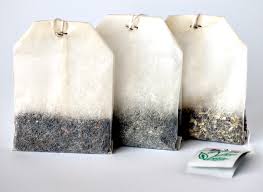
 The arrival of tea in Britain in the seventeenth century altered the drinking habits of this nation forever. The late eighteenth century saw black tea overtake green tea in popularity for the first time, which also encouraged the addition of milk. In the nineteenth century widespread cultivation of tea in India began, leading to the import of Indian tea into Britain overtaking the import of China tea. And in the twentieth century there was a further development that would totally revolutionise our tea-drinking habits – the invention of the tea bag.
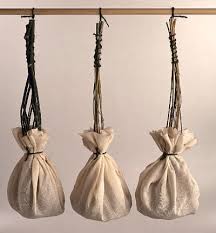
 The tea bag was invented because it was believed that for tea to taste its best, the leaves ought to be removed from the hot water at the end of a specific brewing period. Then there was also the additional benefit of convenience – a removable device means that tea can be made as easily in a mug as in a pot, without the need for a tea strainer, and that tea pots can be kept clean more easily. But the earliest examples of removable infusing devices for holding tea were not bags. Popular infusers included tea eggs and tea balls – perforated metal containers which were filled with loose leaves and immersed in boiling water, and then removed using a chain that was attached to them.
Needless to say, it was in America, which loves labour-saving devices, that tea bags were first developed. In around 1908, Thomas Sullivan, a New York tea merchant, started to send samples of tea to his customers in small silken bags. Some assumed that these were supposed to be used in the same way as the metal infusers, by putting the entire bag into the pot, rather than emptying out the contents and so the tea bag was born by accident. Responding to the comments from his customers that the mesh on the silk was too fine, Sullivan developed sachets made of gauze – the first purpose-made tea bags. During the 1920s these were developed for commercial production, and the bags grew in popularity in the USA. Made first of all from gauze and later from paper, they came in two sizes, a larger bag for the pot, a smaller one for the cup. The features that we still recognise today were already in place – a string that hung over the side so the bag could be removed easily, with a decorated tag on the end.
 While the American population took to tea bags with enthusiasm, the British were somewhat wary of such a radical change in their tea-making methods. This was not helped by horror stories told by Britons who had visited the USA, who reported being served cups of lukewarm water with a tea bag on the side waiting to be dunked into it, which Britons thought totally unacceptable.
The material shortages of World War Two also stalled the mass adoption of tea bags in Britain, and it was not until the 1950s that they really took off. The 1950s were a time when numerous household gadgets were targeted as being tedious household chores, and solutions were offered to remedy the situation; tea bags gained popularity on the grounds that they removed the need to empty out the used tea leaves from the tea pot. The convenience factor was more important to the British tea-drinker than the desire to control the length of infusion time, hence at that time, the Britons often used tea bags that did not have strings attached. It was Tetley in 1953 that really drove the introduction of tea bags in Britain, but other companies soon caught on. In the early 1960s, tea bags made up less than 3 per cent of the British market, but by 2007 tea bags made up a phenomenal 96 per cent of the British market, and there can hardly be a home or workplace in Britain that does not have a stash of the humble, but irreplaceable, tea bag.
The 1920’s was the ‘decade of the teabag’, when its commercial use developed from the tea egg or tea ball into the tea bag. Around 1935 Messrs Joseph Tetley who had a powerful associate company in the States made a tentative approach to market teabags in the UK. Initial approval was slow but Tetley didn’t give up. The teabag market eventually began to grow in the UK in the 1960’s when approximately 5% of tea was consumed in bags. By 1965 it had risen to 7% and now, 96% of tea consumed in the UK is done so with teabags.
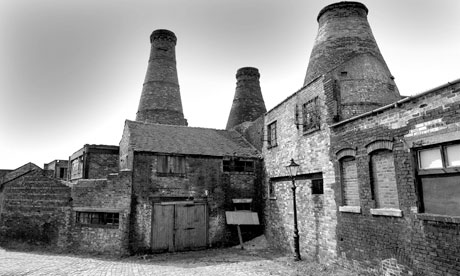 The earliest tea cups had no handles, as they were originally imported from China.. As tea drinking gained popularity, so did the demand for more British-style tea ware. This fuelled the rapid growth of the English pottery and porcelain industry, because of the insatiable appetite for tea. Most factories making tea ware were located in the Midlands area which became known as “The Potteries”. Today, many of the original Potteries are still producing world famous porcelain such as Wedgwood, Royal Doulton and Aynsley.
In the earliest history of tea drinking, tealeaves were simply boiled in open pans. It was the Ming Dynasty that led to the fashion for ‘steeping’ the leaves and therefore led to the need for a covered pot that would allow the leaves to infuse and keep the tea hot. Ewers, resembling the modern teapot, that for centuries had been used for wine were now adapted to brew tea. By the time the Dutch started exporting various exotic cargo from China back to Europe, the concept of the teapot had developed further. The teapots that they brought back were small, with broad bases and wide spouts, which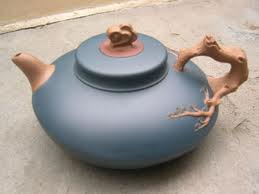 would not clog easily. As Europe had never seen such Chinese stoneware, it took Dutch potters until late 1670’s to reproduce the heat-resistant pots. Two of The Netherlands’ most successful potters the Elers brothers settled in Staffordshire and established the English Pottery industry.
The first containers used for the domestic storage of tea were the jars that arrived from China with shipments of tea. Gradually, European jars and boxes were developed in a wide range of shapes and sizes – round, square and cylindrical boxes, jars and bottles, in silver, crystal, stone and wood. The word ‘caddy’ was not used until the end of the eighteenth century when the word kati – denoting a measure of approximately 1 pound and 5 ounces – was adapted for English usage.
Eighteenth century tea chests or caddies had two or three separate compartments for different teas and sometimes also a mixing bowl or a bowl for sugar. All were lockable, and the lady of the house guarded the keys, as tea was far too precious and expensive to risk being pilfered and the caddy stayed in the family drawing room.
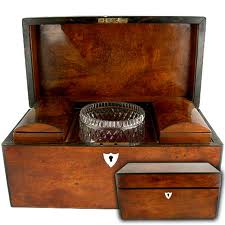
The Chinese started producing fruit shaped containers early in the eighteenth century, and English and German wooden imitations began to appear as pears, apples, strawberries, pineapples. Some were painted but most were varnished and their loose-fitting, hinged lids opened to reveal a foil-lined cavity that held the tea. As the price of tea decreased towards the end of the nineteenth century, tealeaves were transferred to practical tins and boxes that were just stored in the kitchen the use of lockable caddies and ornate jars declined.
The earliest caddy spoons were long-handled ladles made for use with box-like tea chests. From about 1770, short-stemmed caddy spoons began to appear, designed to fit into squatter caddies, often in the form of a miniature scallop shell. This motif originates from the fact that oriental merchants always placed a real scallop shell in the top of tea chests to allow potential buyers to take a sample from the chest before deciding to buy.
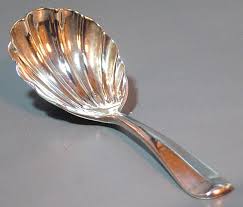 Spoons have been manufactured in the form of leaves, acorns, salmon, thistles and shovels but the most popular has always been the shell, the jockey’s cap, the hand and the eagle’s wing. The ‘caddee shell’ motif also often appears on teaspoons, tea strainers and sugar tongs.
 Caro Field Author
Most enjoyable. I’ll just bet those tins have become very costly as a collectors item. I would love to find one at a rummage sale. I didn’t know that black tea got the milk and green tea got the lemon until I started reading your posts. Are you going to put these articles about tea into a book for kindle?
That’s not a bad idea, William! I hadn’t thought to, but I might just do so!
Wow, Caro, this has been such an interesting series. It figures that it was the Americans who invented the time-saving, effort-saving TEA BAG and the result being a less pleasing cup of tea! I would imagine the horror at the time at that lukewarm cup of tea!
I’m glad you have enjoyed the posts on tea! I must say I enjoyed writing and researching them!
I lived in London in the late ’60. There was not a teabag in sight and my flatmates were very suspicious of them. Lovely post. Enjoyed it very much!
Glad you enjoyed it Carol! There is nothing like a good cuppa of loose leaf tea!
Hmm. That may explain the habits of my grandparents- who never used a cup with a handle!
Haha! Iron hands!
Love, love, love this post. So much great history and some of my fave antiques – caddies!
Glad you enjoyed it, Alessa
This is great! What a well-researched post! It is still morning and I am still having a coffee. Another (unofficial) use of teabags is that, when they are cold, they are great to remove dark circles under the eyes…
They are useful aren’t they?