• About Caro Ness

Caro Field Author

~ Thoughts and musings and poetry

Caro Field Author

Category Archives: non-fiction

The Angler From Angelsea

09 Tuesday Jul 2013

Posted by Caro Field in non-fiction

≈ 1 Comment

images-20I’m of the considered opinion,

Riverbanks are man’s dominion,

And silent solace their greatest wish,

That’s why so many men like to fish.

They resent coming with you to buy your new dress,

It’s boring, time-wasting, well, at least that’s my guess,

But sit transfixed by the river in pouring rain?

That’s a pastime returned to again and again.

Spending hours at a time, with a rod in one hand,

Is something most women just don’t understand.

When you ask them what it is that they think or they do,

The answer is “nothing”, and sadly it’s true!

Teas From the Rest of the World

07 Sunday Jul 2013

Posted by Caro Field in non-fiction

≈ 10 Comments

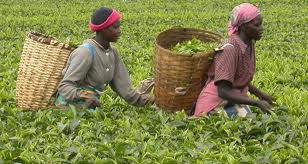
images-10Although not perhaps common knowledge in the West, there are number of other countries that  produce tea. As the most recent of the tea producing countries, Africa has been able to capitalise on the experience of other tea-producing nations. As a result, Africa is now a major force in world tea, producing teas of high quality and good bright colour which are used for blending all over the world. Tea producing countries in Africa include Kenya, Malawi, Tanzania, Zimbabwe and South Africa producing about 32% of world exports amounting to some 424,000 tonnes.

Despite the fact that we perhaps think Kenya more famous for its coffee production,  Kenya is one of the oldest of the African producers, having a history of tea dating back to 1903, when tea seeds from India were first planted on a two acre farm. Today, Kenya has 69000 hectares under cultivation by smallholders (shambas), under the protection of the Kenya Tea Development Authority, and tea producing companies in the public and private sector. Kenya exports over 349,000 tonnes of tea per year (22% of world exports). Kenya’s equatorial climate allows tea growing all year round.

The teas are very bright and colourful, with a reddish coppery tint, and a lovely, lively flavour. Kenya speciality tea is ideal as a drink for any time of day or night and are blended into many famous British brands.

Malawi was the pioneer of tea growing in Africa, with production first starting commercially in the 1880s in Mulanje. Now exporting over 43,000 tonnes annually, Malawi has a 3% share of world exports and is mainly responsible for the spread of tea cultivation in Africa. Malawi was the first African country to adopt the cloning method of estate refurbishment. Although Malawian teas are little-known as speciality teas, their superb colour and brightness means they are used in the blending of many leading British tea brands.

Tea production in Tanzania is thought to be the legacy of German colonisation under the reign of Kaiser Wilhelm II, but actually,  its real development took place under British estate ownership between the two World Wars. Tanzania now exports over 22,000 tonnes of tea annually. All Tanzanian teas are bright in colour with a stimulating flavour that makes them ideal for use in blending. A black cut, torn and curled tea, the  tea from KwaZulu is the only South African tea to be exported for international consumption. The flavour is strong and lively and is best drunk with milk.

Commercial tea production in Zimbabwe only began after the successful establishment of irrigated tea estates. With an average annual rainfall of not more than 26 inches per annum, as opposed to the 50 plus inches per annum usually required, irrigation is essential to encourage and sustain growth. Zimbabwe now exports over 15,000 tonnes of tea per year. Today, tea is a “controlled” commodity in Zimbabwe so that its quality and industry growth are protected.

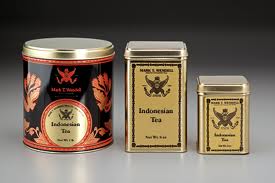
images-12Tea has been part of the way of life in Indonesia for more than 200 years. Situated in the South China Sea and the Pacific Ocean, Indonesia forms an island chain stretching from Malaysia to Papua New Guinea. Java and Sumatra, two of the largest islands, are the main growing areas. After World War II, the Indonesian tea estates were in very poor condition, wrecked factories and tea bushes that had reverted to their wild state were just two of the problems which faced tea planters in the country. By 1984, after a lot of hard work and investment, tea exports from Indonesia began to make their mark on the tea market. Since that time, improvement in tea production and replanting of old estates has continued, with factories investing in new machinery. Now, Indonesia has 142,000 hectares under tea cultivation, with 65,000 of these being on Java. In 2005, Indonesia exported over 102,000 tonnes of tea, accounting for over 7% of world exports. Teas from Indonesia are light and full of flavour. Most are sold for blending purposes as this produces good financial rewards through foreign exchange for the country. In recent years, however, it has become possible to buy Indonesian tea as a speciality. It is extremely refreshing drunk black, garnished with lemon, and is easy on the waistline too.

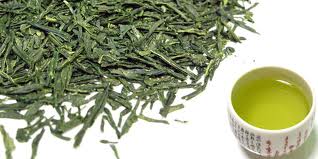
images-13The Japanese have always been known to produce high quality green tea. The worldwide export of Japanese tea has dwindled over the past few decades, almost entirely due to the fact that land and labour costs in Japan are much more expensive than other tea growing regions in the world. Japan has 50,000 hectares planted with tea. The most commonly drunk tea in Japan is Sencha. It has dark green flat needles that produce a pale yellow tea with a light delicate flavour. Gyokuro, which means Precious Dew, is the very best of Japan’s teas and is the one chosen to serve to visitors and for special occasions. The leaves are beautiful, flat, pointed, emerald needles that give a smooth taste and a very subtle aroma, It is a hugely refined tea. Depending on the quality, the water temperature and length of infusion should be adjusted accordingly to give the tea that appeals to your palate.

Teas from India and Sri Lanka

06 Saturday Jul 2013

Posted by Caro Field in non-fiction

≈ Leave a comment

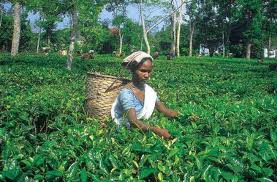
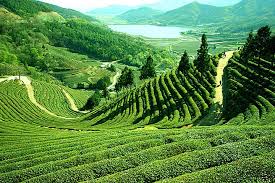
images-5India has 523,000 hectares of tea plants under cultivation, and exports currently more than 12% of the world’s tea. Although tea was native to the Assam region, the first commercially produced teas were actually produced by planting seeds acquired from China. By the 1840s, India was producing regular shipments for sale at auction in London, and gradually the planting of estates grew throughout the country from Nilgiri in the south to Darjeeling in the north. These plantations range from areas at sea level up to 2000ft to plantations at more than 4000 ft. Generally plucked from March to October, each area produces teas of distinctive character. The Tea Board of India has endorsed several speciality blends so that their quality and consistency is assured. Although India produces predominantly black teas, a tiny amount of green tea (1% of total production) is produced, mainly for the market in Afghanistan.

Assam is the major growing area covering the Brahmaputra valley, stretching from the Himalayas down to the Bay of Bengal. There are 655 estates covering some 407,000 hectares. Assam tea has distinctive flecked brown and gold leaves known as “orange” when dried. In flavour it is strong, full-bodied, bright with a smooth, malty pungency and is considered by many as the best way to start the day. Assam teas are used in many popular blends because of their strength and richness. There is also an Assam Green tea with an unusual light, almost sweet flavour, unusual to green tea, which tends toward bitterness.

Assam tea bushes start growing in March and the first flush is picked for 8 to 10 weeks. The first flush Assams, such as Bamonpookri, an excellent quality tea with a strong fresh flavour, are hardly ever marketed outside the Indian sub-continent, unlike first flush Darjeelings. The plucking of the second flush begins in June with most of the production taking place from July to September. The second flush Assam is the best of the season and when brewed gives a deep, round aroma, a clear dark red-brown appearance and a strong malty taste. Good examples of second flush assams are, Napuk, and Thowra, which has a strong spicy flavour and loads of body.

images-8Regarded as the “Champagne of Teas,” Darjeeling is grown on 100 estates in the foothills of the Himalayas, on over 18,000 hectares at about 7000 ft. Light and delicate in flavour and aroma, and with undertones of grape, Darjeeling is an elegant, gentle tea. The first “flushes” (pluckings) are thought to produce the best Darjeeling vintage but all crops are of very high quality. Darjeeling Green is an exceptionally rare tea similar to Japanese Sencha with an exquisite bouquet and delightful, gentle flavour.

The Darjeeling bushes’ first new shoots – the first flush – are picked in April. These first teas of the season are the finest and are much in demand, fetching incredibly high prices at auction. Castleton First Flush, has a perfect green-brown leaf and is from one of the most prestigious gardens in the area. It gives an exquisite perfume and taste of sweet white wine almost. Bloomfield First Flush is also from a highly reputable tea garden and its subtle astringent flavour is typical of Darjeeling first flush.

Second flush Darjeelings are picked between May and June and produce excellent quality teas that are considered by some to be better than the first flush as they have a fruitier, less astringent flavour than the earlier teas. The leaves are a darker brown with a silvery tip. Good examples of second flush Darjeelings are, Puttabong, which has a discernible sweet wine flavour and Namring, a fruitier tea.

There are approximateyl 90,000 hectares of tea being grown in the Nilgiri region, situated in southern India. It is a high plateau, where the Eastern and Western Ghat mountains meet. More than 20,000 smallholders grow and pluck tea here. Most Nilgiri teas are used for blending, but there has recently been a growing demand for this tea as a stand-alone. Nilgiri has a bright amber colour and a refreshing, delicate taste. Nunsch is a typical Nilgiri tea, large-leafed, it produces a fruity, bright and flavourful brew.Teas that are sold as simpply “Indian tea”, are blends of teas from all parts of India, which are often served as afternoon tea. They are robust and refreshing.

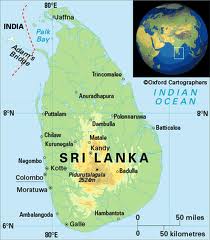
images-9Sri Lanka has over 188,0000 hectares under tea cultivation, yielding about 298,000 tonnes of “made” tea, and accounting for over 19% of world exports. In 1972, the island then known as Ceylon reverted to the traditional name of Sri Lanka, but, interestingly, retained the name of Ceylon for the marketing of teas.

Tea from Sri Lanka falls into three categories: low-grown (on estates up to 2000 ft high); medium grown (between 2000 and 4000 ft); and high grown (over 4000 ft). Each level produces teas of unique character. By blending teas from different areas of the island, Sri Lanka can offer a very wide range of flavour and colour. Some are full-bodied, others light and delicate, but all Ceylon blends will have a full flavour and a bright golden colour. Because of its geographical location, tea can be plucked in Sri Lanka all year round: the west and east of the island are divided by central mountains so that as each region’s season ends, the other begins.

There are a number of famous teas from Ceylon, but probably the most famous of them is Dimbula, which is cultivated on estates first planted with tea when their coffee crops failed in 1870. Grown 5000 ft above sea level, all Dimbula teas are light and bright in colour with a crisp strong flavour that leaves the mouth feeling cleansed. Today, it is grown in part of the high-grown zone of central Sri Lanka which includes Dickoya and Nuwarah Eliya. Kenilworth is a tea that has long, wiry rather beautiful leaves that give a delicate, almost oaky taste and good body and strength. Uva is a fine flavoured tea grown at altitudes between 2,000ft and 4,000ft above sea level on the eastern slopes of the Central Mountains in Sri Lanka. It has a bright, deep amber colour when brewed, with a lively, crisp, strong flavour. These teas are also used in a Ceylon blend and make an ideal morning drink or an after-lunch tea.

Saint James is another Ceylon tea which produces a gorgeous copper-coloured tea with a smooth, strong taste and a wonderful aroma. It is a perfect breakfast tea. Nuwara Eliya teas are light and delicate, bright in colour and have a fragrant flavour. It is always better to drink these teas black, with a slice of lemon, rather than with milk. There is also an estate version that has a bright taste, is wonderfully perfumed, and is delicious at any time of day. Ceylon teas span the entire spectrum of tea production, from low to high grown teas and by blending teas from different areas of the island, Sri Lanka is able to offer a very wide choice of flavour. Some blends are full bodied, others are light and delicate, but all are lively, full flavoured and bright.

China Teas

05 Friday Jul 2013

Posted by Caro Field in non-fiction

≈ 2 Comments

imagesChina is well known as the birthplace of tea. For hundreds of years the country produced the only teas known to the western world. China currently has 1,431,300 hectares planted with tea, and although much of it is produced for the home market, China still accounts for over 18% of world exports.

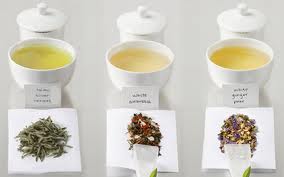
As well as black teas, China produces five other principal teas for which the country is famous: Green, Oolong, White, Flavoured and Compressed teas.  With some exceptions – such as Lapsang Souchong, Gunpowder and Keemun – most teas from China are rarely found in the general marketplace.

Perhaps the most famous china tea is Lapsang Souchong, the best of which is found in the hills in north Fujian. It is a unique large leaf tea distinguished by its smoky aroma and flavour.  The tarry taste is acquired through drying over pine wood fires. Legend has it that the smoking process was discovered by accident.  An army was camping in a tea factory that was full of drying leaves which had to be moved to accommodate the soldiers. When the soldiers left, the leaves needed to be dried quickly, so the workers lit open fires of pinewood to speed up the drying. The tea reached the market on time and a new flavour had been created.

images-1But the real reason why these teas from Fujian province have a smoky flavour is that in the early 17th century when the Chinese tea producers began to export their teas to Europe and America, green teas did not travel well and consequently lost quality during the 15-18 month.  The producers  developed a method of rolling, oxidising and drying the tea so that it would hold its quality for longer.  Once the teas had been oxidised, they were spread on bamboo baskets which were placed on racks in the drying room.  This was built over ovens that allowed the heat to rise up through vents in the ceiling and into the drying room above.  To fire the ovens, the tea manufacturers used the local pine wood from the forests that surrounded the factories, as they do to this day, and as the wood slowly burned, it gave off a certain amount of smoke that was absorbed by the drying tea and gave it a lightly smoked, sappy, pine-like quality..

The factories that made those lightly smoked black teas in Fujian province still manufacture lightly smoked Lapsangs in exactly the same way as they did 400 years ago.  The teas are often called Bohea Lapsangs – the term Bohea being a derivation of ‘Wuyi’, the name of the famous mountain area where these teas are made.  They also manufacture the much smokier Lapsang Souchongs that are popular today.

Keemun is a popular black tea from Anhui Province.  This is a ‘gonfu’ tea – which signifies that it is made with dexterity and skill to produce the thin tight strips of leaf without breaking the leaves. The tight black leaves produce a rich brown tea, which has a lightly scented nutty flavour and delicate aroma.

Yunnan is a black tea from the province of the same name in the south west of China.  It has a rich, earthy, malty flavour similar to Assam teas and is best drunk with milk.  It makes an excellent breakfast tea. Other wonderful Chinese black teas are Keemun Mao Feng (splendidly known as Hair Point) and Szechwan Imperial.

images-5Many green China teas are still  made in the traditional way,  by  using methods that have been handed down from generation to generation. However, more and more teas are now made in mechanised factories. Green teas are totally unoxidised (compared to black teas which are fully oxidised) and so the first stage of the manufacturing process is to kill any enzymes that would otherwise cause oxidation to take place. To de-enzyme them, the freshly plucked leaves are either steamed (to make ‘sencha-type teas) or tumbled quickly in a wok or panning machine (to make pan-fired teas) and are then rolled by hand or machine. Some teas are twisted, some curved, some rolled into little pellets. To remove all but 2-3% of the remaining water, the tea is then dried in hot ovens or over charcoal stoves.

Most Gunpowder tea is produced in Pingshui in Zheijian Province. After it has been pan-fired to de-enzyme it, the leaf is rolled into small pellets and then dried. The pellets look remarkably like lead shot or gunpowder, giving the tea its descriptive name. The pellets come in different sizes – the smaller the leaf plucked and rolled, the smaller the pellet – and grades range from tiny ‘pinhead’ gunpowder to larger ‘peahead’ gunpowder. Gunpowder tea has a soft honey or coppery liquor with a herby smooth light taste.

Chun Mee literally means ‘precious eyebrows’ and the shape of the leaves give the tea its name. The processing of ‘eyebrow’ teas demands great skill in order to hand roll and dry the leaves to the correct shape at the right temperature for the correct length of time. These long, fine jade leaves give a clear, pale yellow liquor with a smooth taste. Other Chinese green teas include Longjing (Dragon’s Well) from Zheijiang; Taiping Hon Kui (Monkey King) from Anhui; and Youngxi Huo Qing (Firegreen).

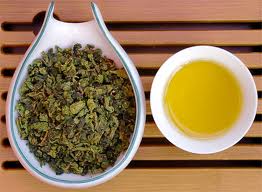
images-8Oolong is traditionally found in China’s Fujian province and Taiwan. Oolongs  are semi-oxidised teas that vary from greenish rolled oolongs (that give a light, floral drink, reminiscent of lily of the valley, narcissus, orchid or hyacinth) to dark brown leafed oolongs that produce a drink  with deeper, earthier flavours and lingering hints of peach and apricot. There are two ways to make oolongs. To manufacture the darker leafed oolongs, the freshly plucked leaf is withered, then shaken or ‘rattled’ in bamboo baskets or in a bamboo tumbling machine to slightly bruise parts of the leaf, then oxidised for a short time so that the bruised parts of the leaf begin to oxidise. When 60-70% oxidation has been reached, the leaf is dried.

To manufacture the greener oolongs, the leaf is withered and then wrapped inside a large cloth and rolled in a special machine. The bag is then opened and the leaf is spread out briefly to oxidise lightly. The leaf is repeatedly wrapped, rolled and oxidised until approximately 30% oxidation has been achieved. The tea is then dried to remove all but 2-3% of the remaining water. The most famous of these greener, light, fragrant oolongs is Tie Kuan YIn which has a hyacinth or narcissus character. All oolongs are better drunk black – which is fine by me, it’s the way I drink my tea anyway!

Tie Kuan Yin, an oolong, is made in China’s Fuijan province and in Taiwan. The name means ‘Tea of the Iron Goddess of Mercy’ who is said to have appeared in a dream to a local tea farmer, telling him to look in a cave behind her temple. There he found a single tea shoot that he planted and cultivated. The bush he grew is said to have been the parent bush from which all future tea plants have been cultivated to make this highly fragrant tea. It is today one of the most sought after oolongs around the world. Other recommended China oolong teas are Fonghwang Tan-chung, Shui Hsien (Water Sprite), Oolong Sechung and Wuyi Liu Hsiang, Huan Jin Qui (Yellow Golden Flower), Da Hong Pao (Great Red Robe), Loui Gui (Meat Flower) and Wuyi Yan (Bohea Rock).

Also cultivated in China’s Fujian province and Taiwan, pouchong teas are more lightly oxidised than most oolong teas. The name means ‘the wrapped kind’ which refers to the fact that the tea was traditionally wrapped in paper after the manufacturing process when the tea was ready for sale. Long, stylish black leaves brew a very mild cup with an amber infusion, floral overtones and a very smooth, sweet taste.

imagesWhite teas traditionally come from China’s Fujian province too and are made from leaf buds and leaves of the Da Bai (Big White) tea varietal by the simplest process of all teas. The manufacturing process includes no withering, no steaming, no rolling, no oxidising and no shaping – very young new leaf buds and baby leaves are simply gathered and dried, usually in the sun. The best known white teas are Pai Mu Tan (White Peony) which is made using new leaf buds and a few very young leaves, and Yin Zhen (Silver Needles) which is made from just the new leaf buds.Pai Mu Tan Imperial is a rare white tea that is made from very small buds and a few baby leaves that are picked in the early spring, and once dried,  look like lots of tiny white blossoms with a few darker leaves surrounding the white bud – from which it’s name arises, ‘White Peony’. Yin Zhen is also from Fuijan province. This tea is made from tender new buds that are covered in silvery white hairs and it’s name means ‘Silver Needles’.

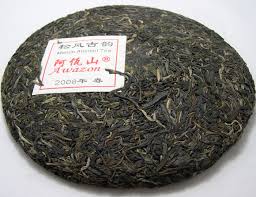
Puerh tea is named after Puerh city in Yunnan province, which was once the main trading centre for teas made in the area, so the official Chinese definition for Puerh tea is “Products fermented from green tea of big leaves picked within Yunnan province”. However, even Chinese specialists cannot agree on the true definition but, in general terms, Puerh teas are teas from Yunnan that are aged for up to 50 years in humidity- and temperature-controlled conditions to produce teas that have a typically earthy, yet smooth flavour and aroma. There are two types of Puerh tea made by two different methods of manufacture: Naturally Fermented Puerh tea (also known as Raw Tea or Sheng Tea) and Artificially Fermented Puerh tea (also known as Ripe Tea or Shou Tea).

images-1To make Naturally Fermented Puerh tea, leaves picked from the bush are withered, de-enzymed in a wok, twisted and rolled by hand, dried in the sun, steamed to soften them and then either left loose or compressed into flat cakes or blocks. The tea is then stored in controlled conditions to age and acquire its typically earthy character. To make Artificially Fermented Puerh tea, the tea leaves are picked, withered, de-enzymed in a wok, twisted and rolled by hand, dried in the sun and then mixed with water, piled, covered with large ‘blankets’ made from hide and left to ferment. The tea is stirred at intervals and the whole process takes several weeks. When the teas have fermented to a suitable level, they are steamed and then left loose or compressed in the same way as Naturally Fermented Puerh teas. The teas are then stored in damp, cool conditions to age. Naturally Fermented Puerh teas are left for at least 15 for up to 50 years! Artificially Fermented Puerh teas are aged for only a few weeks or months. When ready, each cake of Puerh tea is wrapped in tissue paper or dried bamboo leaves. The reason for manufacturing Puerh teas by artificial fermentation is to allow the tea producers to make more Puerh in a shorter time. 50 years is a long time to wait for a good Puerh so the more modern artificial method was developed to meet a growing demand for these teas.

Compressed tea include Tuancha, meaning ‘tea balls’ and are made in differing sizes, the smallest being half the size of a table tennis ball. These little balls are often made from Puerh aged tea and have an earthy flavour and aroma. Originally from Yunnan province, Tuocha, also a compressed tea, is usually a Puerh tea that has been compressed into a bird’s nest shape and has a similar earthy, elemental taste.

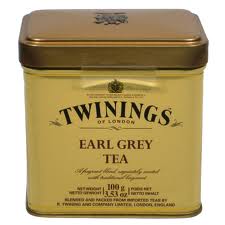
images-3Lastly, there are the flavoured/scented teas, such as Jasmine, a china tea which has been dried with Jasmine blossoms placed between the layers of tea. The tea therefore has a light, delicate Jasmine aroma and flavour.Or how about Rose Congon, a large-leafed black tea scented with rose petals. The manufacture of ‘gongfu’ teas demand great skill in the handling of the leaves, the temperature control and the timing of each part of the process.The most famous of the flavoured or scented teas is of course, Earl Grey. Traditionally, this is a blend of black China teas treated with natural oils of the citrus Bergamot fruit which gives the tea it’s perfumed aroma and flavour. Earl Grey tea is said to have originally been blended for the second Earl Grey by a mandarin after Britain had completed a successful diplomatic mission to China. There are a number of other scented China teas that are popular, including Osmanthus, Magnolia, Orchid, Chloranthus and Lychee.

The Boston Tea Party

03 Wednesday Jul 2013

Posted by Caro Field in non-fiction

≈ 6 Comments

IMG_0454Tea is such a thoroughly British drink somehow, and taking time for a cup of tea is how millions choose to grab a moment of peace in the midst of our hectic lives. It seems a little incongruous to remember that a little over 250 years ago, tea was such a hot political issue in America that it led to event that changed history forever. This was the infamous Boston Tea Party, a protest against tea duties in December 1773 that sparked off the American War of Independence and therefore eventually led to the United States of America becoming an independent nation instead of a group of British colonies.

During the eighteenth century, tea drinking was as popular in Britain’s American colonies as it was in Britain itself. Legally, all tea imported into America had to be shipped from Britain, and all tea imported into Britain had to be shipped in by the British East India Company. However, for most of the eighteenth century, the East India Company was not allowed to export directly to America. But during the 1770s the East India Company ran into financial problems: illegal tea smuggling into Britain was radically affecting the amount of tea being bought from them. This led to its profits plummeting and an increase in its stockpile of unsold tea. In an attempt to avoid bankruptcy, the company asked the British government for permission to export tea direct to America, a move that would enable it to get rid of its surplus stock of tea. The company actually owed the government £1 million, so the government had no desire to let them go bankrupt. So in 1773 the Tea Act was passed, granting the Company the right to export and allowing a duty of 3d per lb to be levied on the exports to America.

The British government didn’t think that this would be a problem because exporting directly to America, the cost of tea there would actually become cheaper, and 3d per lb was considerably less duty than was paid on tea destined for the British market. But it seriously underestimated the strength of American resistance to being taxed at all by the British. Taxation had long been a point of heated debate and most Americans objected on principle to being taxed by a parliament which didn’t represent them. Instead, they wanted to raise taxes themselves to fund their own administration. But successive British governments reserved the right to tax the colonies, and consequently, the American opposition hardened.

In the late 1760s, they started boycotting taxed goods, to show their rebellion. To replace them, the Americans either bought smuggled goods or attempted to find substitutes made from native products. These included such things as ‘Labrador tea’, which was made from the leaves of a plant that flourished in the colonies, and ‘Balsamic hyperion’, made from dried raspberry leaves. The successful boycott of such a popular domestic product as tea was made possible because American women, who were on the whole responsible for household purchases, actively supported it . An anonymous American commentator writing some years later declared that by refusing to purchase imported tea, ‘American ladies exhibited a spirit of patriotism and self-devotedness highly honourable to their sex’.

images-1In 1770, the British government repealed most of the import duties – with the exception of the duty on tea, which remained at 3d per lb, but the maintenance of duty in the Tea Act of 1773 rekindled the Americans’ anger. They were further incensed by the decision of Parliament that the East India Company would have the monopoly on the distribution of tea in America, using its own agents instead of established American tea merchants, which seemed like an attempt to put patriotic Americans out of business.

The colonists were united in their decision to refuse to pay the tax on tea. Regardless of the opposition, the East India Company pressed ahead with its plans, and in autumn 1773 four ships, Dartmouth, Eleanor, Beaver and William, set sail for Boston with their precious cargo of tea. In the weeks that these ships were sailing, the American opposition grew. The Massachusetts Gazette reported a meeting in early November at which Bostonians resolved that no one would import any tea that was liable for duty, and that anyone who aided or abetted the East India Company would be considered an ‘enemy of America’. There were further public meetings against the tax, and warehouses for which the tea was destined were even attacked.

When Dartmouth reached America on 28 November 1773, the townspeople refused to let it be brought ashore or the duty paid. But the customs officers completed the necessary paperwork for the import of the tea, after which the ship could not legally set sail for England with the tea still on board. A few days later Eleanor arrived, followed by Beaver, which had been delayed by an outbreak of smallpox onboard. William had run aground and was stranded near Cape Cod. So the three ships languished in the harbour at Griffin’s Wharf in Boston, waiting for the situation to be resolved.

A deadlock arose because the townspeople wouldn’t allow the tea to be brought ashore unless an agreement was reached that no duty would be paid on it. The Governor of Massachusetts, Thomas Hutchinson, refused to let the ships leave port without paying duty on the tea. An armed guard of patriots was posted at the wharf to prevent the tea coming ashore, while a naval blockade of the harbour prevented the ships from leaving. Mass meetings were held by the resistance leaders, Samuel Adams and Josiah Quincy, and the Bostonians were further buoyed up by messages of support which they received from all over New England.

On 16 December, perhaps as many as 7,000 local people met at the Old South Meeting House to debate the situation. Francis Rotch, the American owner of two of the ships, attended the meeting. He was in the unfortunate position of being reluctant to risk infuriating his countrymen by bringing the tea ashore, but yet knowing that if he ordered the ships to set sail illegally he risked them being sunk or taken by the navy. Rotch went to see Governor Hutchinson, to demand a pass for the ships to leave port, with the tea still onboard. The Governor refused, and Rotch returned to the meeting to break the news. The townspeople were faced with a stalemate, and so decided that drastic action was required.

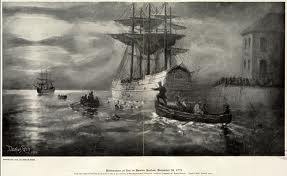
images-3In the early evening of 16 December, a band of men, some disguised as American Indians by blackening their faces, met on a hill above the town. Whooping Indian-style war cries, they marched to the wharf, boarded the ships one after another, hoisted the tea on board deck, split open all the tea chests – 342 in total – and threw the tea into the sea. The whole affair took about three hours, and it was a completely peaceful protest, the protesters even swept the decks clean afterwards. The Massachusetts Gazette later reported the fact that a padlock that had been broken was the personal property of one of the ships’ captains, and so it was replaced. Hewes also recorded that anyone caught attempting to steal any of the tea for personal consumption was punished by the Bostonians.

The following morning large quantities of tea were still floating in the harbour waters, so to prevent any being salvaged, men went out in rowing boats and pushed the tea beneath the surface of the water with their oars. A joke went round for months afterwards that fish taken from American waters tasted strongly of tea.

This Tea Party sparked off other protests: tea being shipped to New York and Philadelphia was sent back to London, while tea off-loaded at Charleston was left to rot in the warehouses. In retaliation, the British government passed five laws in early 1774 that became known as the Intolerable Acts. Although intended primarily to punish the people of Massachusetts (the Acts included closing the port of Boston until the tea was paid for, restricting town meetings and giving the British-appointed governor more power), in the event the Acts played a key role in uniting the 13 American colonies against British rule.

In September 1774, representatives of the colonies, including Samuel Adams, one of the Bostonian resistance leaders, met at the First Continental Congress to discuss resistance against the Acts. The united resistance of the colonies would lead to the American Revolution and the Declaration of Independence, which was signed in July 1776, just three years after the Boston Tea Party.

The East India Company

02 Tuesday Jul 2013

Posted by Caro Field in non-fiction

≈ 2 Comments

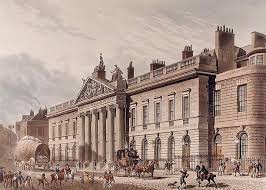
images-5The Btritish East India Company was easily the most powerful commercial organisation that the world has ever known. At the height of  its influence, it not only had a monopoly on British trade with India and the Far East, but it was also governed most of the Indian sub-continent. These two factors mean that the East India Company was crucial to the history of the tea trade.

Before 1600, Portugal controlled most trade between Europe, India and the Far East. However, in 1600 Queen Elizabeth I gave a royal charter to a new trading company, the East India Company, by which it was given a monopoly over all British trade with the Indies. The Company soon began competing with the Portuguese, as did similar companies, set up in the Netherlands, Denmark and France. The East India Company’s first major base was in western India, where it found a rich source of exotic textiles amongst other things, which could be exported back to Britain or taken further east to exchange for spices.

The Company successfully negotiated its way through the stormy wters  that were British politics in the seventeenth century. Oliver Cromwell provided the merchants with a new charter after Charles I was deposed and the Commonwealth established in 1649. Then when Charles II was restored to the throne in 1660, the Company managed to persuade him to extend its privileges to allow the Company to take military action if necessary, t establish future trading grounds or posts.

Catherine of Breganza, the Portuguese princess who had grown up with a taste for tea, married Charles II in 1662, and tea gradually became a fashionable drink in courtly and aristocratic circles.This was made possible by the East India Company, which in 1664 placed its first order for tea – for 100lbs of China tea to be imported from Java into Britain. This steady supply continued until 1678, when an import of 4,713lbs swamped the market until 1685, when 12,070lbs was imported, swamping the market again. This pattern continued until the end of the century.

The eighteenth century proved very different. Tea drinking realy began to appeal to the masses, and the East India Company’s imports rocketed. By 1750, annual imports had reached 4,727,992lbs, tea drinking really took hold as an activity for the whole population, and the East India Company’s imports rocketed.

images-10In actual fact however, tea was still hugely expensive, partly because of the Company’s monopoly on the trade and partly because of the extortionate taxes imposed upon it. To satisfy the demand of the less wealthy, an enormous amount of tea was smuggled into Britain and sold illegally. This situation continued for years, until William Pitt the Younger came to power as Prime Minister in 1783. With the Commutation Act of 1784, he slashed the tax on tea so dramatically that smuggling became pointless. Thereafter virtually all tea was imported legally by the East India Company.

In the decades leading up to Pitt the Younger’s Commutation Act, tea smuggling had really crippled the East India Company. Needing to increase profits and offload surplus tea that the Company had accumulated during the worst years of the smuggling, it asked the British government for permission to export direct to America, which at this time was still a British colony. Permission was granted, and it was decided that the tea would carry a tax of 3d per lb. The Americans were outraged, many considered such British-imposed taxes wrong because they wished to self-govern. There wasalso the small matter of the East India  Company having the monopoly on distribution, another move that was intended to help it out of financial trouble, but which offended the Americans who felt they should have the right to distribute their own tea.

When the Company’s ships arrived in Boston in late 1773, the townspeople were determined that the tea should not be brought ashore nor the duty on it on paid. But the colonial administration would not allow the ships to leave port. The deadlock eventually resulted in the Boston Tea Party, when a mass of townspeople, dressed as Native Americans, boarded the ships and threw all the cargo of tea overboard. This was one of the key events that eventually sparked the American War of Independence.

When America eventually won independence from British rule in 1783, it began its own free and independent tea trade with China. The success of this trade made some people in Britain question the wisdom of allowing the East India Company a continued monopoly on British trade with the East.They felt there should be free trade instead. In 1813, the Company lost its monopoly on trade with India, but still had a complete monopoly on trade with China, which meant it was heavily dependent on the tea trade. The Company’s charter was due for renewal in 1834, and in the decades before that there was a growing call for the abolition of the monopoly and the instigation of free trade with China as well. Supporters of free trade argued strongly that the Company kept tea prices artificially high in order to maximise its profits, using tactics which included restricting the supply of tea.

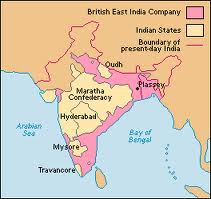
The movement gathered pace, and committees were set up by free trade organisations to examine the evidence. The report of one such committee in 1828 claimed that the restriction of supply by the East India Company, and the artificially high prices, had actually driven down the annual consumption of duty-paid tea per person in Britain, from almost 28oz in 1800 to just 20oz in 1828. An added complication was that  Charles II’s charter to the Company had allowed it to use military force where necessary to establish trading stations, and in the seventeenth and eigthteenth centuries it established many well-fortified trading posts in India. Over the course of the eighteenth century, the control of the Mughal Emperor in Delhi was in decline, with independent regional princes taking power instead. But unhappy with this turn of events, the Company increasingly used its private army to establish governmental control over large territories of India. By the beginning of the nineteenth century, with help from the British army, the Company had conquered about half of India

images-9Thus India was being ruled by tea  merchants from the East India Company boardroom in Leadenhall St, London. This caused great concern to many in Britain, who considered the dual roles of merchant and ruler to be completely incompatible. In 1834, Parliament’s new charter for the Company abolished its trading functions altogether. Instead, the Company became an agent of the British government, administering British India on behalf of the Crown. India was still to be ruled from the boardroom of the East India Company, but its rulers would no longer also be tea dealers. China was still the major source of tea, and since the Company had now been relieved of any trading rights with China, its thoughts turned to the possibility of growing tea in India. Previously, when the Company had had a monopoly on the Chinese trade, it had not been in its interests to encourage cultivation of tea elsewhere.

A Tea Committee was established to investigate where in India might be most suitable for the cultivation of tea plants and seed imported from China, and to oversee that cultivation. One obvious area was Assam, where indigenous tea plants had already been found growing. Seeds from China were germinated in Calcutta and then sent on to Assam and other areas to conduct trials. C.A. Bruce, an agent of the East India Company in Assam, was appointed Superintendent of Tea Forests and set about cultivating plantations of both China tea and indigenous tea.

In 1838 12 chests of Assam tea were sent to the East India Company in London. Some was used for public relations purposes and the rest went to the  London Tea Auction. This was the first auction of Assam tea in London, and the novelty of the product ensured that it got a very good price. Bruce’s experiment had been a resounding success. A new organisation, the Assam Company, was formed to exploit the potential of Assam tea. By 1855 tea cultivation in Assam amounted to over half a million lbs.

Despite the fact that the East India Company had lost its trading rights, but it had not lost its desire to make money. The cost of the Company’s of India administration was met through punitive taxation of the Indian people. There were localised rebellions and the Company used increasingly heavy-handed tactics to control the Indian population. In May 1857 three regiments of Indian soldiers serving in the Company’s army at Meerut near Delhi rebelled. The revolt spread, and led to a vicious conflict as the British forces tried to put it down. The rebellion lasted over a year, during which time both sides committed acts of terrible cruelty. Even after peace was established, the trust between the Indians and the East India Company administration was destroyed. The British government decided that enough was enough, and directly assumed all the Company’s powers and possessions in India. The first viceroy, Lord Canning, was appointed to govern British India.

The power of the East India Company was well and truly over, but the success of Indian tea production was just beginning. With the exception of Darjeeling, which was producing high-quality but low-yielding tea crops, there was little tea cultivation outside Assam. The new British administration in India saw the potential for more widespread cultivation and offered generous land leases to would-be tea planters. By 1888 Indian tea production had reached 86 million lbs – and for the first time British tea imports from India exceeded those from China.

The Tea Ceremony

01 Monday Jul 2013

Posted by Caro Field in non-fiction

≈ 12 Comments

Tags

P

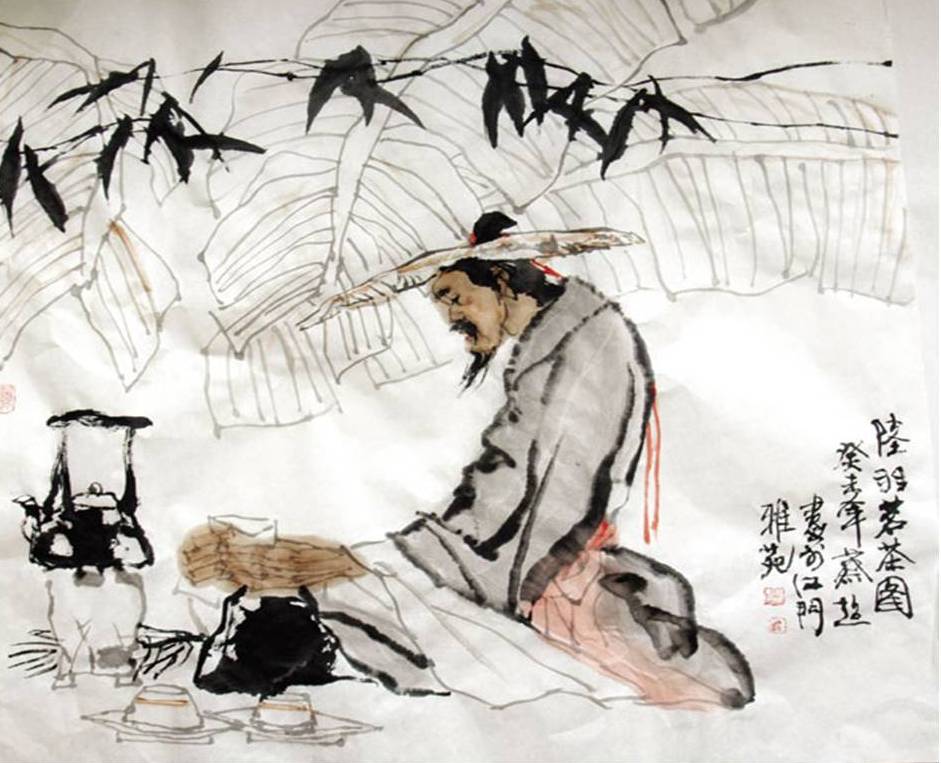
lu yu-1Lu Yu’s book, the Ch’a Ching, or The Classic of Tea, was hugely popular in his homeland of China, but its influence was particularly potently felt in Japan, where it led to the foundation of the Tea Ceremony. This ritual, known as Ch’a No Yu, has elevated the preparation and drinking of tea to an art form which continues to flourish to this day.

Tea was almost certainly introduced to Japan by Buddhist monks, and certainly originally, tea drinking remained the exclusive preserve of the the Buddhist priesthood. But in 1119, a Zen Buddhist monk by the name of Eisai brought new seeds back from China to Japan, along with knowledge of Lu Yu’s book, and so laid the foundations for the Japanese Tea Ceremony.

This ritual is based on Zen Buddhist monks’ belief that the right preparation and consumption of tea is an aid and stimulant for deeper meditation. The ceremony caught on and gained in popularity, and Eisai went on to pen the first book on tea in Japan, the Kitcha Yojoki or Book of Tea Sanitation.

As the popularity of the beverage gained momentum, there was a commensurate interest in the Tea Ceremony, which soon became regarded as the most unique and quintessential way of expressing a degree of social sophistication, in the most exquisite of settings. And much more than that, it expressed the Zen Buddhist belief that the small, everyday chore is as important as the most crucial universal spiritual principle. That the mindful ritual of making tea, celebrated the greatness that can be found in the humblest of everyday tasks, and that the grace and delicacy with which the tea ceremony is performed is an outward display of the importance of an inner peace and harmoniousness.

Don’t get me wrong! This beautiful ceremony took a while to gain footing. Originally, the tea ceremonies were somewhat riotous affairs, with copious amounts of alcohol drunk alongside the tea! Gradually, however, they got more and more refined, partly due to three Tea Masters. The last of these, Sen No Rikyu (1522-1591), who lived in Kyoto, is responsible for introducing all the Zen elements to the Tea Ceremony. It is the form he developed, chado, the way of tea, that is practiced in the Japanese Tea Ceremony to this day.

Sen No Rikyu became personal Tea Master to the powerful politician, Hideyoshi, and his chief aide. The relationship between the two men was strong until other courtiers, jealous of his influence, turned Hideyoshi against him, and he was forced to commit seppuku, ritual suicide.

Despite this horrible death, Rikyu’s sons and grandsons continued to practice chado and today, the Urasenke Tea tradition (the largest of the different Ways of Tea) is headed by Grandmaster Zabosai Sen Shoshitsu XVI, the sixteenth generation of direct descendants of Rikyu to hold the post.

images-13

The tea ceremony itself takes place in a Sukiyu, a simple wooden building with a sloping roof. There is an anteroom, a midsuya, a small chamber where the utensils are washed, laid out and prepared, a portico or machiai where guests wait to be summoned into the tea room, and a path through the garden that surrounds the tea room, the roji, that connects the world outside with the haven of calm that is the tea room.

In a sense, the roji represents the journey we must make to reach this inner point of peaceful tranquility. So the walk through the garden is the start of the meditation, representing as it does a step away from the clamour of the outside world, and should be done in silence and in order of precedence. Samurai warriors were obliged to leave their swords on a rack for the purpose. Each guest bent low to get through the door to the tea room, a feature designed to imbue each guest with a sense of humility.

The Chanoyu ceremony takes place in a wooden or bamboo teahouse called a Chashitsu. There is usually room for four people. The garden around the teahouse is very simple with lots of green plants rather than flowers, a small rock garden, and a stream. A path winds its way through the garden leading to the teahouse. If you are invited to a Chanoyu tea ceremony there are certain rules you need to follow.

First you must wait at the entrance to the garden until you are calm and ready to step into it. The Teishu or tea master welcomes you when you are in the garden. He or she brings fresh water for you to drink and to wash your hands. Now you follow the Teishu along the path to the teahouse. Once iinside the teahouse, the Teishu makes the tea using powdered green tea called ‘matcha’. The tea is mixed with boiled water using a bamboo whisk and served in small bowls.

Guests sit on the floor of the teahouse around a low table. When the Teishu gives a guest a bowl of tea, they should bow, take the bowl with the left hand, and then hold it with the right hand. They then place the bowl in front of them and turn it to the right so that they don’t drink from the side that was facing them. Usually the Teishu gives each guest a sweet cake or a mochi to eat as well because the tea is bitter.
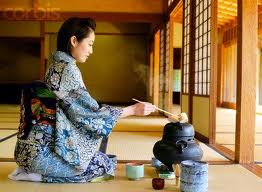
images-3When the guest has finished their tea, they should turn the bowl to the left and place it on the table in front of them – having drunk it all! They then turn the bowl to show the Teishu respect: this means that the edge of the cup he gave the guest was the best, but the guest is not the Teishu’s equal, so not good enough to drink from that side. Sometimes the guests share one bowl that they pass around.

The Sencha ceremony, is more relaxed than the Chanoyu ceremony. The rules for serving the tea are traditional but the occasion is more easy-going for the tea drinkers. Most people in Japan don’t have their own teahouse but they often belong to a ‘tea club’ where they go every week to take part in the tea ceremony.

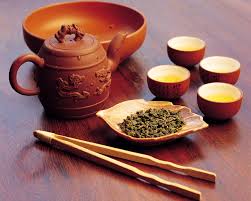
The art of drinking and serving tea in China is much more relaxed and the taste and the smell of the tea are the most important parts of the ceremony, so the rules for making and pouring the tea are not always the same. In most of China tea is made in small clay teapots. The pot is rinsed with boiling water and then the tea leaves are added to the pot using chopsticks or a bamboo scoop. The tea leaves are rinsed in hot water in the pot and then hot water is added to the leaves to make the tea. The temperature of the water is all important. It needs to be hot but if it is too hot it can spoil the taste. The art of preparing and making tea is called Cha Dao.

In less than a minute, the server pours the tea into small narrow cups but he doesn’t pour one cup at a time. Instead the cups are arranged in a circle and the server pours the tea in all of them in one go. He fills the cups just over half way. The Chinese believe that the rest of the cup is filled with friendship and affection. The server then passes a cup to each guest and invites him or her to smell the tea first. You should thank him by tapping on the table three times with your finger. Next each guest pours their tea into a drinking cup and they are asked to smell the empty narrow cup. Finally they drink the tea. It is considered polite to empty the cup in three swallows. If you drink tea in a teahouse or restaurant is it called Yum Cha, yum is to drink and cha is tea.
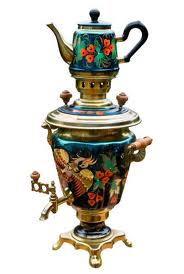
images-14Tea is probably Russia’s favourite drink after vodka! It is made and served in teapots or samovars – a Russian tea kettle, which are often decorated with images from folk lore or fairy tale. Some tea drinkers use three teapots that sit on top of one another. The middle pot usually holds strong black tea, the small pot on the top holds herbal or mint tea, and the large pot on the bottom holds hot water. The teas can be mixed with each other and diluted with hot water as each cup is poured. Everyone can mix the type of tea they like. Tea is drunk from cups but more often Russians use a podstakanniki – a special glass in a silver holder and the tea is usually drunk after meals rather than with a meal, but when tea is made using a samovar it is ready for use throughout the day. A samovar is shaped like an urn and there is a special place for a small teapot to sit on the top. Water is heated in the samovar and a strong dark tea is made using lots of tea leaves in the teapot on top. The strong tea is called zavarka. The tea is so strong that it has to be diluted with water from the samovar before it can be drunk. A drop of tea is mixed with hot water taken from the tap or spout on the front of the samovar. As the water is used you need to refill the samovar and every few hours you have to make a fresh pot of black tea. Some samovars are small and only hold about three litres of water but some can hold up to 30 litres. Samovars are usually made from metal and are commonplace in a Russian home or restaurant.

Tea ceremonies in both North and South Korea are similar to those held in Japan and China but are more informal than the ceremonies in Japan. Korean Buddhists monks spend many hours meditating and use the tea ceremony to help them meditate. But Koreans in general, see tea ceremonies as spiritual occasions that are closely associated with their religion. ‘Tea,’ they say, ‘is a healthy, enjoyable and stimulating drink, full of good qualities. It reduces loneliness and calms your heart; it is a comfort in everyday life’.

There are tea rooms in most cities and even small towns in Korea where friends can gather and drink tea together. Many Koreans today still have tea ceremonies for important occasions including birthdays and anniversaries. From 1392-1910, tea ceremonies were performed regularly at palaces in Korea. The “Day Tea Rite” was a common daytime ceremony, but the “Special Tea Rite” was reserved for specific occasions, including royal weddings and visits from leaders of other countries. There was one tea ceremony, however, to which the king was not invited. This was the Queen Tea Ceremony. The only male guest was the crown prince, the eldest son of the Queen. The other guests were female friends, family and servants of the Queen.

Cha Ching or The Classic of Tea

30 Sunday Jun 2013

Posted by Caro Field in non-fiction

≈ 2 Comments

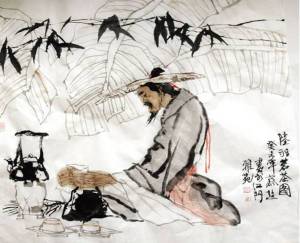
20130629-060640.jpgBy the time Lu Yu wrote his classic treatise on tea, in the eighth century, tea was a popular drink in China. However, although little is known about the man himself, his book proved to be hugely influential in giving the drink its cultural importance. What we do know is that he was a scholar from Hupei Province, in Southern China, where tea cultivation was widespread, so this might be why he wrote his book.

The Ch’a Chung elevated tea to an almost religious experience. The tea drinker is exhorted to use specific implements, each of which is endowed with a particular significance. There are also guidelines on the state of mind to drink tea and the environment in which it should be done.

The Taoist faith was central to Chinese culture in eighth century China, with its emphasis on celebrating every aspect of life. It is hardly surprising therefore, that a book on the tranquility and calm engendered by the preparation and drinking of tea would find favour.

The Ch’a Chung opens with a description of the tea plant, its cultivation and processing and even when to pick it, on a clear day apparently! It continues with outlining the 24 implements required to make it and how each one should be used correctly. These implements number amongst others, the brazier for heating the water, the roller needed to break up the bricks of tea at that time, the receptacles from which to drink it, the pot in which it was contained. Lu Yu even went so far as to say that if any one of his listed implements were missing from tea-making, the whole experience of tea should be dispensed with because it just wouldn’t be as it should be.

He now expounds on the quality of different waters used to make the tea and declares water from slow-flowing rivers up in the mountains to be the most superior. He then describes the different stages if boiling it and finally how it should be drunk.

After listing painstakingly every stage in the preparation of tea, it is unsurprising that Lu Yu advocates sipping the tea very slowly in order to savour each drop and consuming just 3 cups, or at the most 5. He abhors the addition of many additives that we consider normal today, such as lemon or ginger, and approves of the addition of only one ingredient, salt, which we would consider abhorrent!

Lu Yu’s insistence on ritual and formality may be alien to us today, when we just squeeze in a quick cuppa to calm us in the midst if a busy day but in reality, the notions behind the drinking of tea are identical. Lu Yu wanted to convey the notion that the preparation and drinking of tea should be done in tranquility, and if done correctly, would lead to a greater sense of calm and well-being. This notion is not so many miles away from the advert, ‘Keep Calm, Drink Tea’.

20130629-061338.jpg

Tea Cultivation

28 Friday Jun 2013

Posted by Caro Field in non-fiction

≈ 16 Comments

220px-Camellia_sinensis_-_Köhler–s_Medizinal-Pflanzen-025Tea, Camellia sinensis, is an evergreen plant that grows mainly in tropical or subtropical climates. It is part of the Theaceae family. One or two varieties can also tolerate marine climates and are cultivated as far north as Pembrokeshire on the British mainland and Washington in the United States.

Interestingly, the name Camellia is taken from the Latinized name of Rev. Georg Kamel,(1661–1706), a Czech-born Jesuit lay brother, pharmacist, and missionary to the Philippines. Carl Linnaeus chose the name in 1753 for the genus to honor Kamel’s contributions to botany, although in actual fact, Kamel did not discover or name this plant, or any Camellia, and Linnaeus did not consider this plant a Camellia but a Thea. Robert Sweet later changed all formerly Thea species to the Camellia genus in 1818. The name sinensis means Chinese in Latin.

Tea plants are propagated from seed and cutting; it takes about 4 to 12 years. Tea plants require a zone 8 climate or warmer (meaning it can tolerate temperatures as low as (-12º to -9.4º C (10-15º F), tea plants require at least 127 cm (50 inches) of rainfall a year and prefer an acidic soil to grow in. Tea plants prefer a rich and moist soil to grow in, in full to part sun. Tea is commercially cultivated from the equator to as far north as the UK mainland. Many high quality teas are grown at high elevations, up to 1500 meters (5,000 ft) or more above sea level, as the plants grow more slowly and acquire more flavour. At such rarified heights, the plants grow more slowly and acquire a significantly better flavour. A tea plant will grow into a trree of up to 16 m (52 ft) if left undisturbed, but cultivated plants are generally pruned to waist height so that they can be picked more easily.

Only the top 1–2 inches (2.54-5.08 cm) of the mature plant are picked. These buds and leaves are called flushes. A plant will grow a new flush every seven to fifteen days during the growing season. Leaves that are slow in development tend to produce better-flavoured teas. Tea’s main pests include mosquitos bugs that tear and tatter the leaves, so they are sprayed with insecticides if there is any danger of this happening.

Just like wine, the provenance of the plant (soil, climate and altitude) radically affects its flavour, the processing or blending of it tends to affect its characteristics. There are some 1500 different varieties of tea on the market today from 36 countries, so we are spoilt for choice.

Tea is grown on estates or small holdings. A small holding may be as small as 0.5 hectares, in which case several smallholders get together and send their tea to a factory en masse. An estate is a much larger enterprise, with its own factory.

Today tea is grown from cuttings or clones in special nurseries, and, when ready to be planted out, is done so 1.5 m apart with a meter distance between each row. In higher altitudes the tea is planted to follow the contours of the mountainside to avoid soil erosion.

The bushes are picked every 7-14 days.
The two factors governing how long the bush is left to regrow are climate and altitude. A tea plant grown at sea level will recover far more quickly than one grown at altitude.

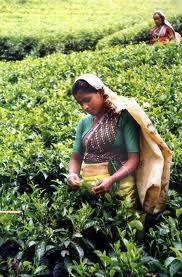
The plucked leaves are placed in a basket on each picker’s back. When full, they are taken to a collection point or straight to the factory, if close by, for weighing before it is processed or ‘made’ as it is known in the trade. On an estate, each plucker is credited with their own weights of tea for subsequent payment. A skilled plucker can gather between 30-35 k of plucked leaf in a day, sufficient to produce about 7.5 to 9 kg of processed black tea.

Two principal varieties of tea are used: Camellia sinensis var. sinensis, which is used in most Chinese, Formosan and Japanese teas, and Camellia sinensis var. Assamica, used in Pu-erh and most Indian teas, with the exception of Darjeeling. Within these two botanical varietials, there are many strains and modern cloned varieties. Leaf size is the chief criterion for the classification of tea plants, with three primary classifications as follows:

  • Assam type, characterised by the largest leaves
  • China type, characterised by the smallest leaves
  • Cambod, characterised by leaves of intermediate size.

There are three main kinds of tea produced in India:

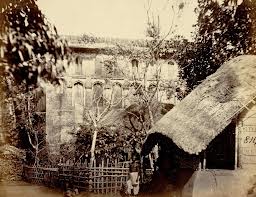
Assam tea comes from the northeastern section of the country. This heavily forested region is home to much wildlife, including the Indian rhinoceros. Tea from here is rich and full-bodied. It was in Assam that the first tea estate was established, in 1837.

The region from which Darjeeling comes is cool and wet, and tucked in the foothills of the Himalayas. The tea is delicately flavored, and considered to be one of the finest teas in the world. The Darjeeling plantations have 3 distinct harvests, termed ‘flushes’, and the tea produced from each flush has a unique flavor. First (spring) flush teas are light and aromatic, while the second (summer) flush produces tea with a bit more oomph. The third, or autumn flush gives a tea that is not so fine in quality.

Nilgiri tea comes from an even higher part of India than Darjeeling. This southern Indian region has elevations between 1,000 and 2,500 metres. The flavors of Nilgiri teas are subtle and very gentle. They are frequently blended with other, more robust teas to give them a rounder, mellower flavour.

Where tea is concerned, you should follow a couple of simple rules:

The smaller the leaf, the more expensive the tea.

Teas can generally be divided into categories based on how they are processed.

200px-Camellia_sinensis-frutoThere are at least six different types of tea: white, yellow, green, oolong, black (known as red tea in China) and post-fermented tea (or black tea in China) of which the most commonly found on the market are white, green, oolong, and black. Some varieties, such as traditional oolong tea and Pu-erh tea, a post-fermented tea, can be used medicinally, as well as just drunk for pleasure.

Although single estate teas are now readily available, almost all popular teas are available in tea bags and most other teas sold in the West are now blends. Blending may occur in the tea-planting area (as in the case of Assam), or teas from multiple areas may be blended together elsewhere. The aim of blending is to obtain better taste, higher price, or both, as a more expensive, better-tasting tea may cover the inferior taste of cheaper varieties. Some commercial teas have been enhanced through additives or special processing. Tea easily retains odors; this can cause problems in processing, transportation, and storage, but also allows for the design of an almost endless range of scented and flavoured variants, such as bergamot (Earl Grey).

The History of Tea

27 Thursday Jun 2013

Posted by Caro Field in non-fiction

≈ 4 Comments

images-10Tea. An obsession for many worldwide. Pouring boiling water over the aromatic leaves of the tea plant, Camelia sinensis, has been a pastime willingly partaken by many for centuries as it is the most refreshing of beverages. As they say, little can’t be solved by sitting down to a nice cuppa tea!

Legend has it that the herbalist, Shen Nung was sitting under a tea tree whilst his servant was boiling some water for him to drink. Leaves from the tea accidentally blew into the brew and he decided to taste the resulting concoction and tea was born!

Whether or not there is even the modicum of truth to this story, it is likely that the origins of tea lie in China during the Shang Dynasty (1600-1046 BC), when it was consumed as a medicinal beverage. The Portugese priests and traders passing through China in the 16th Century then were introduced to it and brought it back to Europe, at which time it was called cha. The British became firm fans in the 17th century and they, in turn, introduced it to India in the hope that it would grow successfully there and break the Chinese monopoly on the product.

Tea plants are native to East and South Asia, and probably originated where the lands of northeast India, north Burma and southwest China meet. A number of techniques, including cluster analysis, chromosome numbers and hybridisation, suggests that there is likely a single place of origin for Camellia sinensis, an area including the northern part of Burma, Yunnan, and Sichuan province in China.

There is no exact proof as to where tea originated but a Chinese inventor was the first person to invent such a machine as a tea shredder and the first recorded drinking of tea is general Liu Kun during the Qin Dynasty. An old Chinese legend attributes the invention of tea to Shennong in 2737 BC. Tombs from the Han Dynasty, (206 BC – 220 AD) have been unearthed with tea containers in them.

It was a drink enjoyed by the masses during the Qin Dynasty (third century BC) and became increasingly popular during the Tang Dynasty (618-906 AD), when it’s use spread to Korea, Japan and Vietnam and it became the national drink of China. In the eighth century, a man called Lu Yu wrote the first book entirely about tea, the Cha Ching, or Tea Classic.

In India it has been drunk for medicinal purposes for a long but unkown length of time, but apart from the Himalayan region, it does not seem to have been used as a beverage until the British introduced it. Meanwhile, the Europeans were lagging behind in the discovery of tea! It was undoubtedly the Portugese traders and missionaries who originally brought it home but it was actually the Dutch who began commercial trading in tea. They established a trading post on the island of Java and it was from there, in 1806, that the first commercial shipment of tea was sent to Holland.

In 1750, tea experts travelled from China to the Azores, to plant tea, along with jasmines and mallows, to give the tea aroma and a distinctive quality. Both green and black tea continue to grow in the islands, which are the main suppliers to continental Portugal to this day. Catherine of Braganza, wife of Charles II, brought the obsession with tea-drinking to Great Britain around 1660, but tea was not widely consumed in Britain until the 18th century, and only by the aristocracy, and remained expensive until the latter part of the century. This was largely due to the punitive taxation of it, which was originally 25p in the pound! It was only as recently as 1964, that taxation on tea was finally abolished.

In Britain and Ireland, tea became an everyday drink for all levels of society by the late 19th century, but it was originally drunk as a luxury item only on special occasions, such as religious festivals, or wakes. And by the landed gentry, who were the only ones who could afford it. The price in Europe fell steadily during the 19th century, because Indian tea began to arrive in large quantities and flooded the market.

The first European to successfully transplant tea to the Himalayas, was Robert Fortune, who was sent by the East India Company on a mission to China in 1848 to bring the tea plant back to Great Britain. He began his journey in high secrecy as his mission occurred in the lull between the two Anglo-Chinese Opium Wars and westerners were not welcome at the time.

images-12Tea was first introduced into India by the British, in an attempt to break the Chinese monopoly on tea. The British tried bringing in Chinese seeds to Northeast India but the plants failed, then they discovered that a variety of tea was indigenous to Assam and the Northeast region of India and used by local tribes. Using the Chinese planting and cultivating techniques, the British launched a tea industry by offering land in Assam to any European who agreed to cultivate tea for export.Tea was originally only consumed by anglicised Indians, it was not until the 1950s that tea grew more widely popular in India through a successful advertising campaign by the India Tea Board.

There are two different words for tea: “te” and “cha” The words that various nations use for “tea” reveal where those countries first acquired their tea and tea culture.

  • Portuguese traders were the first Europeans to import the herb in large amounts. They borrowed their word for tea (chá) from Cantonese in the 1550s via their trading posts in the south of China, especially in Macau
  • In Central Asia, the Mandarin word cha developed into the Persian word chay, and this then spread everywhere that Persian trade and cultural influence was strong.
  • The Russians use the word cha because they encountered tea in Central Asia.
  • The Burmese word for tea, laphet, pronounced does not fall into either of the two main groups. Laphet means wet tea, as opposed to dried tea, because they drink pickled or fermented tea
  • The Dutch word for tea (thee) comes from the Min dialect. The Dutch may have borrowed their word for tea through trade directly from Fujian or from Fujianese or Malay traders in Java. From 1610 on, the Dutch played a dominant role in the early European tea trade, via the Dutch East India Company influencing other languages to use the Dutch word for tea. Other European languages whose words for tea derive from the Min dialect (via Dutch) include English, French (thé), Spanish (te), and German (Tee).
  • The Dutch first introduced tea to England in 1644. By the 19th century, most British tea was purchased directly from merchants in Canton, whose population uses cha, though the English never replaced the Dutch-derived Min word for tea, char is often used as the slang word for tea…The word char for tea arose from its Cantonese Chinese pronunciation “cha” with its spelling affected by the fact that ar is a more common way of representing the word in British English.
  • In North America, the word chai is used to refer almost exclusively to the Indian masala chai or spiced tea, in contrast to tea itself.
  • However, in Moroccan colloquial Arabic, ash-shay means generic, or black Middle Eastern tea whereas at-tay refers particularly to Zhejiang or Fujian green tea with fresh mint leaves. The Moroccans are said to have acquired this taste for green tea,— quite unique in the Arab world — for East Chinese green tea after the ruler Mulay Hassan exchanged some European hostages captured by the Barbary pirates for a whole ship of Chinese tea!
  • The colloquial Greek word for tea is tsáï, from Slavic chai. Its formal equivalent, used in earlier centuries, is téïon, from tê.
  • The Polish word for a tea-kettle is czajnik, which could be derived directly from chai or from the Russian word for tea. However, tea in Polish is herbata, which, as well as Lithuanian arbata, was derived from the Latin herba thea, meaning tea herb.
  • The normal word for tea in Finnish is tee, which is taken from Swedish. However, it is often colloquially referred to, especially in Eastern Finland and in Helsinki, as tsai, tsaiju, saiju or saikka, which is close to the Russian word chai. The latter word refers always to black tea, while green tea is always tee.
  • In Ireland, in Dublin in particular, the term cha is sometimes used for tea, as is tay (from which the Gaelic word tae is derived. Char was a common slang term for tea throughout the British Empire and Commonwealth military forces in the 19th and 20th centuries, and its usage crossed over into civilian usage.

images-11Tea is the second most consumed beverage in the world, after water, yet in some cultures it is taken on more elevated occasions, such as the tea ceremony in China and Japan, which use precise rituals to brew and serve the tea in a refined setting, such as the tea house. One such tea ceremony is the Gongfu tea ceremony, which uses a small Yixing clay teapot and oolong tea.

Tea is a permanent fixture in most countries but in Arab cultures, it is considered a focal point for any social gathering. In Pakistan, both black and green tea are very popular. The favored green tea known as kahwah is served after every meal in the Pashtun and Khyber regions. In Kashmir, Kashmiri chai or noon chai is served at weddings and throughout the winter months at kiosks at the side of the road. This tea is made with pistachios, almonds, cardamom and occasionally cinnamon and is a pink, creamy tea. In Punjab, a similar concoction, known as chai, is the preferred domestic drink. But in Borthern Pakistan, a salty, buttered, Tibetan-style tea is the tea of choice. If you are a visitor to Iran, tea will almost certainly be the first thing offered to you.

In the USA and Canada, about 80% of the tea drunk will be consumed as iced tea. In Switzerland too, iced tea is popular but they also add Alpjne herbs to the mix, alongside the more usual lemon. In India, tea has been declared the national drink and is consumed daily, in copious quantities. When bought from a street vendor, it is bought in doses of small cups, rather than one large one, and these cups are known as cutting cups. Here, in the UK, tea is considered a part of our culture and (according to Goscinny & Uderzo, in Asterix in Britain, even battles are not exempt) ‘everything stops for tea.’

← Older posts
Newer posts →

A Four Letter Word – Buy Here

My Facebook Page

My Facebook Page

Enter your email address to follow this blog and receive notifications of new posts by email.

Join 1,534 other subscribers

Gallery

This slideshow requires JavaScript.

Blog Stats

  • 97,123 hits

Tags

artwork barcelona beach bear bend boat books brazil bridge butterfly canal caravan cars cats celebrity chef child chimes china Crowcombe desert dogs drinks eca embellishment equestrian fame flowers France friendship green guitar handbags happiness home Italy Japan joy lavender London love map music nature O P poetry puddings rain rainbow river rivers rosd salmon sand sea ships shoes shopping sky sleigh snow somerset spain stardom statue sunrise sunset The Road to Crowcombe trees walk walking weather winter world

Blog at WordPress.com.

  • Subscribe Subscribed
    • Caro Field Author
    • Join 409 other subscribers
    • Already have a WordPress.com account? Log in now.
    • Caro Field Author
    • Subscribe Subscribed
    • Sign up
    • Log in
    • Report this content
    • View site in Reader
    • Manage subscriptions
    • Collapse this bar
 

Loading Comments...