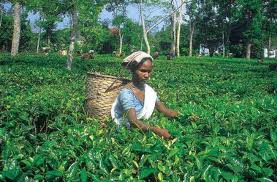
 India has 523,000 hectares of tea plants under cultivation, and exports currently more than 12% of the world’s tea. Although tea was native to the Assam region, the first commercially produced teas were actually produced by planting seeds acquired from China. By the 1840s, India was producing regular shipments for sale at auction in London, and gradually the planting of estates grew throughout the country from Nilgiri in the south to Darjeeling in the north. These plantations range from areas at sea level up to 2000ft to plantations at more than 4000 ft. Generally plucked from March to October, each area produces teas of distinctive character. The Tea Board of India has endorsed several speciality blends so that their quality and consistency is assured. Although India produces predominantly black teas, a tiny amount of green tea (1% of total production) is produced, mainly for the market in Afghanistan.
Assam is the major growing area covering the Brahmaputra valley, stretching from the Himalayas down to the Bay of Bengal. There are 655 estates covering some 407,000 hectares. Assam tea has distinctive flecked brown and gold leaves known as “orange” when dried. In flavour it is strong, full-bodied, bright with a smooth, malty pungency and is considered by many as the best way to start the day. Assam teas are used in many popular blends because of their strength and richness. There is also an Assam Green tea with an unusual light, almost sweet flavour, unusual to green tea, which tends toward bitterness.
Assam tea bushes start growing in March and the first flush is picked for 8 to 10 weeks. The first flush Assams, such as Bamonpookri, an excellent quality tea with a strong fresh flavour, are hardly ever marketed outside the Indian sub-continent, unlike first flush Darjeelings. The plucking of the second flush begins in June with most of the production taking place from July to September. The second flush Assam is the best of the season and when brewed gives a deep, round aroma, a clear dark red-brown appearance and a strong malty taste. Good examples of second flush assams are, Napuk, and Thowra, which has a strong spicy flavour and loads of body.
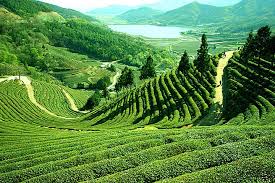 Regarded as the “Champagne of Teas,” Darjeeling is grown on 100 estates in the foothills of the Himalayas, on over 18,000 hectares at about 7000 ft. Light and delicate in flavour and aroma, and with undertones of grape, Darjeeling is an elegant, gentle tea. The first “flushes” (pluckings) are thought to produce the best Darjeeling vintage but all crops are of very high quality. Darjeeling Green is an exceptionally rare tea similar to Japanese Sencha with an exquisite bouquet and delightful, gentle flavour.
The Darjeeling bushes’ first new shoots – the first flush – are picked in April. These first teas of the season are the finest and are much in demand, fetching incredibly high prices at auction. Castleton First Flush, has a perfect green-brown leaf and is from one of the most prestigious gardens in the area. It gives an exquisite perfume and taste of sweet white wine almost. Bloomfield First Flush is also from a highly reputable tea garden and its subtle astringent flavour is typical of Darjeeling first flush.
Second flush Darjeelings are picked between May and June and produce excellent quality teas that are considered by some to be better than the first flush as they have a fruitier, less astringent flavour than the earlier teas. The leaves are a darker brown with a silvery tip. Good examples of second flush Darjeelings are, Puttabong, which has a discernible sweet wine flavour and Namring, a fruitier tea.
There are approximateyl 90,000 hectares of tea being grown in the Nilgiri region, situated in southern India. It is a high plateau, where the Eastern and Western Ghat mountains meet. More than 20,000 smallholders grow and pluck tea here. Most Nilgiri teas are used for blending, but there has recently been a growing demand for this tea as a stand-alone. Nilgiri has a bright amber colour and a refreshing, delicate taste. Nunsch is a typical Nilgiri tea, large-leafed, it produces a fruity, bright and flavourful brew.Teas that are sold as simpply “Indian tea”, are blends of teas from all parts of India, which are often served as afternoon tea. They are robust and refreshing.
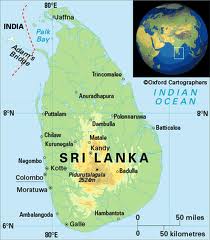 Sri Lanka has over 188,0000 hectares under tea cultivation, yielding about 298,000 tonnes of “made” tea, and accounting for over 19% of world exports. In 1972, the island then known as Ceylon reverted to the traditional name of Sri Lanka, but, interestingly, retained the name of Ceylon for the marketing of teas.
Tea from Sri Lanka falls into three categories: low-grown (on estates up to 2000 ft high); medium grown (between 2000 and 4000 ft); and high grown (over 4000 ft). Each level produces teas of unique character. By blending teas from different areas of the island, Sri Lanka can offer a very wide range of flavour and colour. Some are full-bodied, others light and delicate, but all Ceylon blends will have a full flavour and a bright golden colour. Because of its geographical location, tea can be plucked in Sri Lanka all year round: the west and east of the island are divided by central mountains so that as each region’s season ends, the other begins.
There are a number of famous teas from Ceylon, but probably the most famous of them is Dimbula, which is cultivated on estates first planted with tea when their coffee crops failed in 1870. Grown 5000 ft above sea level, all Dimbula teas are light and bright in colour with a crisp strong flavour that leaves the mouth feeling cleansed. Today, it is grown in part of the high-grown zone of central Sri Lanka which includes Dickoya and Nuwarah Eliya. Kenilworth is a tea that has long, wiry rather beautiful leaves that give a delicate, almost oaky taste and good body and strength. Uva is a fine flavoured tea grown at altitudes between 2,000ft and 4,000ft above sea level on the eastern slopes of the Central Mountains in Sri Lanka. It has a bright, deep amber colour when brewed, with a lively, crisp, strong flavour. These teas are also used in a Ceylon blend and make an ideal morning drink or an after-lunch tea.
Saint James is another Ceylon tea which produces a gorgeous copper-coloured tea with a smooth, strong taste and a wonderful aroma. It is a perfect breakfast tea. Nuwara Eliya teas are light and delicate, bright in colour and have a fragrant flavour. It is always better to drink these teas black, with a slice of lemon, rather than with milk. There is also an estate version that has a bright taste, is wonderfully perfumed, and is delicious at any time of day. Ceylon teas span the entire spectrum of tea production, from low to high grown teas and by blending teas from different areas of the island, Sri Lanka is able to offer a very wide choice of flavour. Some blends are full bodied, others are light and delicate, but all are lively, full flavoured and bright.
 Caro Field Author