
 Tea is such a thoroughly British drink somehow, and taking time for a cup of tea is how millions choose to grab a moment of peace in the midst of our hectic lives. It seems a little incongruous to remember that a little over 250 years ago, tea was such a hot political issue in America that it led to event that changed history forever. This was the infamous Boston Tea Party, a protest against tea duties in December 1773 that sparked off the American War of Independence and therefore eventually led to the United States of America becoming an independent nation instead of a group of British colonies.
During the eighteenth century, tea drinking was as popular in Britain’s American colonies as it was in Britain itself. Legally, all tea imported into America had to be shipped from Britain, and all tea imported into Britain had to be shipped in by the British East India Company. However, for most of the eighteenth century, the East India Company was not allowed to export directly to America. But during the 1770s the East India Company ran into financial problems: illegal tea smuggling into Britain was radically affecting the amount of tea being bought from them. This led to its profits plummeting and an increase in its stockpile of unsold tea. In an attempt to avoid bankruptcy, the company asked the British government for permission to export tea direct to America, a move that would enable it to get rid of its surplus stock of tea. The company actually owed the government £1 million, so the government had no desire to let them go bankrupt. So in 1773 the Tea Act was passed, granting the Company the right to export and allowing a duty of 3d per lb to be levied on the exports to America.
The British government didn’t think that this would be a problem because exporting directly to America, the cost of tea there would actually become cheaper, and 3d per lb was considerably less duty than was paid on tea destined for the British market. But it seriously underestimated the strength of American resistance to being taxed at all by the British. Taxation had long been a point of heated debate and most Americans objected on principle to being taxed by a parliament which didn’t represent them. Instead, they wanted to raise taxes themselves to fund their own administration. But successive British governments reserved the right to tax the colonies, and consequently, the American opposition hardened.
In the late 1760s, they started boycotting taxed goods, to show their rebellion. To replace them, the Americans either bought smuggled goods or attempted to find substitutes made from native products. These included such things as ‘Labrador tea’, which was made from the leaves of a plant that flourished in the colonies, and ‘Balsamic hyperion’, made from dried raspberry leaves. The successful boycott of such a popular domestic product as tea was made possible because American women, who were on the whole responsible for household purchases, actively supported it . An anonymous American commentator writing some years later declared that by refusing to purchase imported tea, ‘American ladies exhibited a spirit of patriotism and self-devotedness highly honourable to their sex’.
 In 1770, the British government repealed most of the import duties – with the exception of the duty on tea, which remained at 3d per lb, but the maintenance of duty in the Tea Act of 1773 rekindled the Americans’ anger. They were further incensed by the decision of Parliament that the East India Company would have the monopoly on the distribution of tea in America, using its own agents instead of established American tea merchants, which seemed like an attempt to put patriotic Americans out of business.
The colonists were united in their decision to refuse to pay the tax on tea. Regardless of the opposition, the East India Company pressed ahead with its plans, and in autumn 1773 four ships, Dartmouth, Eleanor, Beaver and William, set sail for Boston with their precious cargo of tea. In the weeks that these ships were sailing, the American opposition grew. The Massachusetts Gazette reported a meeting in early November at which Bostonians resolved that no one would import any tea that was liable for duty, and that anyone who aided or abetted the East India Company would be considered an ‘enemy of America’. There were further public meetings against the tax, and warehouses for which the tea was destined were even attacked.
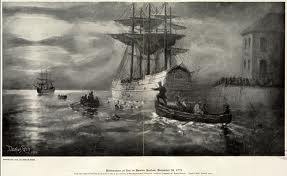
When Dartmouth reached America on 28 November 1773, the townspeople refused to let it be brought ashore or the duty paid. But the customs officers completed the necessary paperwork for the import of the tea, after which the ship could not legally set sail for England with the tea still on board. A few days later Eleanor arrived, followed by Beaver, which had been delayed by an outbreak of smallpox onboard. William had run aground and was stranded near Cape Cod. So the three ships languished in the harbour at Griffin’s Wharf in Boston, waiting for the situation to be resolved.
A deadlock arose because the townspeople wouldn’t allow the tea to be brought ashore unless an agreement was reached that no duty would be paid on it. The Governor of Massachusetts, Thomas Hutchinson, refused to let the ships leave port without paying duty on the tea. An armed guard of patriots was posted at the wharf to prevent the tea coming ashore, while a naval blockade of the harbour prevented the ships from leaving. Mass meetings were held by the resistance leaders, Samuel Adams and Josiah Quincy, and the Bostonians were further buoyed up by messages of support which they received from all over New England.
On 16 December, perhaps as many as 7,000 local people met at the Old South Meeting House to debate the situation. Francis Rotch, the American owner of two of the ships, attended the meeting. He was in the unfortunate position of being reluctant to risk infuriating his countrymen by bringing the tea ashore, but yet knowing that if he ordered the ships to set sail illegally he risked them being sunk or taken by the navy. Rotch went to see Governor Hutchinson, to demand a pass for the ships to leave port, with the tea still onboard. The Governor refused, and Rotch returned to the meeting to break the news. The townspeople were faced with a stalemate, and so decided that drastic action was required.
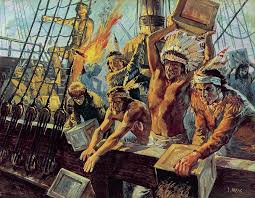 In the early evening of 16 December, a band of men, some disguised as American Indians by blackening their faces, met on a hill above the town. Whooping Indian-style war cries, they marched to the wharf, boarded the ships one after another, hoisted the tea on board deck, split open all the tea chests – 342 in total – and threw the tea into the sea. The whole affair took about three hours, and it was a completely peaceful protest, the protesters even swept the decks clean afterwards. The Massachusetts Gazette later reported the fact that a padlock that had been broken was the personal property of one of the ships’ captains, and so it was replaced. Hewes also recorded that anyone caught attempting to steal any of the tea for personal consumption was punished by the Bostonians.
The following morning large quantities of tea were still floating in the harbour waters, so to prevent any being salvaged, men went out in rowing boats and pushed the tea beneath the surface of the water with their oars. A joke went round for months afterwards that fish taken from American waters tasted strongly of tea.
This Tea Party sparked off other protests: tea being shipped to New York and Philadelphia was sent back to London, while tea off-loaded at Charleston was left to rot in the warehouses. In retaliation, the British government passed five laws in early 1774 that became known as the Intolerable Acts. Although intended primarily to punish the people of Massachusetts (the Acts included closing the port of Boston until the tea was paid for, restricting town meetings and giving the British-appointed governor more power), in the event the Acts played a key role in uniting the 13 American colonies against British rule.
In September 1774, representatives of the colonies, including Samuel Adams, one of the Bostonian resistance leaders, met at the First Continental Congress to discuss resistance against the Acts. The united resistance of the colonies would lead to the American Revolution and the Declaration of Independence, which was signed in July 1776, just three years after the Boston Tea Party.
 Caro Field Author
Interesting point of view.
It is clear that it was not just the tax- but the fact that the British government demanded that a British company take over a business in a foreign land (to benefit itself)- was just another nail in the door, trying to close the burgeoning feeling of free commerce in the colonies. It was the competing desires of who runs “business” (including the regulation of even the miniscule acts that affect people in the colonies) that stoked the fires of rebellion and repression. Not much different that occurred in much of the falling British empire of the 1800s and 1900s.
I think that’s what Caro actually says in her post !!!!!!
I have to say, I couldn’t disapprove more of the way the British behaved if I tried…
Greed always ends in discontent…
What a great post! FULL of history and details. Would be fun to see a re-enactment!
Thanks Carol. I must confess, I am ashamed of my forebears and the greed they showed and impressed by the American non- violence in the face of severe provocation!