
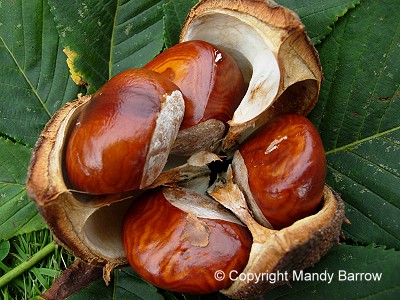
 The Horse Chestnut (Aesculus hippocastanum) was first introduced to Britain from the Balkans in the late 16th century, but it was not until about 200 years later that the fruits of the horse chestnut trees were used to play “conkers”. Before that, “conkers” was played with hazelnuts, cobnuts or snail shells. The fruits of this tree resemble those of the Sweet Chestnut (Castanea sativa) tree but they are inedible. As with sweet chestnuts they develop in prickly cases, and are ripe in September and October – the ‘conker’ season.
The “horse” connection is derived from the fact that horse chestnuts were fed to horses in the East as a stimulant and to make their coats shine and the leaf-scars on the twigs have the shape of a horseshoe, including the nail holes. There is also a theory that the prefix ‘horse’ is a corruption of the Welsh gwres, meaning hot, fierce, or pungent, i.e. ‘Horse-chestnut’ = the bitter chestnut, as opposed to the mild, sweet one.
Conkers have been carried in people’s pockets to help prevent piles and rheumatism, and used in wardrobes to keep away moths. According to a letter which appeared in the Daily Telegraph, conkers, placed in the corners of a room and behind pieces of furniture, keep spiders out of the house. But the most famous use of the Horse Chestnut is of course the game of Conkers.
The game of conkers probably evolved from a game called ‘conquerors’, which was originally played with snail (conch) shells. A variant of the game was later played with hazelnuts or cobnuts, on strings. By the 20th century these earlier games had almost universally been replaced by the version we now know using horse chestnuts. The first game of conkers was recorded on the Isle of Wight in 1848.
There are, of course, many regional variations in the rules of the game and it has also been known by different names. In parts of the Midlands around Worcestershire it was known as ‘oblionker’ (pronounced obly-onker) and play was accompanied by such rhymes as ‘Obli, obli, onker, my first conker (conquer)’. The word oblionker apparently being a meaningless invention to rhyme with the word conquer, which has by degrees become applied to the nut itself.
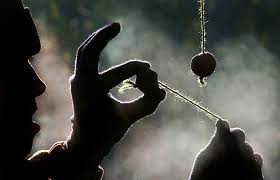
The autumn is the beginning of the season for the game when all over the country children start collecting conkers. Choose a big, round conker and then bore a hole through the middle of it, usinng a skewer or compass. Thread a piece of string through the hole and tie a knot at one end, so that it doesn’t pull through. The string should be long enough to wrap twice around your clenched hand and still have about 10 inches (25 cm) left. A toss of the coin usually decides who starts first but in the school playground, where it is an addiction, who starts first is more often than not, a matter of whoever shouts something like ‘Obli, obli oh, my first go.’
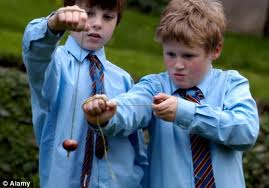
Each player has a conker on a knotted string. Players take turns at hitting their opponent’s conker. If you are the one whose conker is to be hit first, then you let it hang down from the string which is wrapped round your hand. A 10 inch (25 cm) drop is about right. You must hold it at the height your opponent chooses and you must hold it perfectly still. Your opponent, the striker, wraps their conker string round his hand just like yours. He then takes the conker in the other hand and draws it back for the strike. Releasing the conker he swings it down by the string held in the other hand and tries to hit her/his opponent’s conker with it. If he misses he is allowed up to two further goes. If the strings tangle, the first player to call “strings” or “snags” gets an extra shot. Players take alternate hits at their opponent’s conker. The game is won when one player destroys the other’s conker. If a player drops his conker or it is knocked from his hand, the other player can shout “stamps” and immediately stamps on the conker; but should its owner first shout “no stamps” then “stamps” is disallowed and the conker with luck remains intact.
In playground tournaments a winning conker can then go on to do battle with other conkers, each victory adding to the conker’s score. A conker which has won one battle is called a “one-er”, two battles a “two-er” and so on. So for example, you might overhear a child saying “I beat his fiver with my twoer”. In this case, and depending on which rules you play by, the winning twoer might simply become a three-er or it might become an eighter (two previous victories plus the victory over the fiver plus the five-score of the fiver). In this way winning conkers can quickly accumulate quite large scores!
The kudos of having a high-ranked winning conker is not limited to the playground and there have been many traditional ways of (illegally) hardening conkers before battling. Known hardening methods have included soaking or boiling the conkers in vinegar or salt water; soaking in paraffin; partially baking them for about a half hour in the oven to case-harden them; coating them with clear nail-varnish; filling them with glue or simply storing them in the dark for a year (since the shrivelled ones often seem to destroy the young shiny ones).
At the World Conker Championships in Ashton, Northamptonshire, Ashton Conker Club supplies the conkers ready drilled and laced to ensure fair play, thus preventing the use of such tricks to harden the nuts. Competition rules do not allow “stamps”, while “snags” do not give an extra swing – in fact causing “snags” is considered bad sportsmanship and can lead to disqualification.
Here are the World Conker Championships official rules:
- All Conkers and Laces are supplied by Ashton Conker Club. Laces must not be knotted further or tampered with. Each player is given a new conker and lace at the start of each game. Players may not re-use conkers from earlier games.
- The game will commence with a toss of a coin, the winner of the toss may elect to strike or receive.
- A distance of no less than 8″ or 20cm of lace must be between knuckle and nut.
- Each player then takes three alternate strikes at the opponent’s conker.
- Each attempted strike must be clearly aimed at the nut, no deliberate mis-hits.
- The game will be decided once one of the conkers is smashed.
- A small piece of nut or skin remaining shall be judged out, it must be enough to mount an attack.
- If both nuts smash at the same time then the match shall be replayed.
- Any nut being knocked from the lace but not smashing may be re-threaded and the game continued.
- A player causing a knotting of the laces (a snag) will be noted, three snags will lead to disqualification.
- If a game lasts for more than five minutes then play will halt and the “5 minute rule” will come into effect. Each player will be allowed up to nine further strikes at their opponents nut, again alternating three strikes each. If neither conker has been smashed at the end of the nine strikes then the player who strikes the nut the most times during this period will be judged the winner.
The first World Conker Championship was held at Ashton in Northamptonshire, England in 1965,on the second Sunday in October. That tradition survives, so this year’s World Conker Championships will be held at Southwick near Oundle, Northamptonshire on 13th October 2013.
In North America, the game currently has no official status, but the North American Conker Championship was inaugurated in 2012 in the town of Annapolis Royal, Nova Scotia. It is sometimes simply known as “chestnuts”. The game was played during the late 1940s and early 1950s in New York in the Flatbush section of Brooklyn, the Catholic areas of North Cambridge, MA in the late 1950s, and in the 1950s and early 1960s in the Amalgamated section of the Bronx, in Queens, the upper West Side of Manhattan, the Mohawk Valley area of upstate New York and in Westmount, Quebec and other English-speaking parts of Montreal into the 1970s, and on Rhode Island in the 1980s. A winning chestnut was referred to as a “killer”.
 Caro Field Author
I’m intrigued by the Part 1 subtitle. Is there more? I didn’t know there was so much to know about conkers 🙂
Ah! The Part II is a poem about them tomorrow! We love your new site BTW!
My husband played a similar game with horse chestnuts in a suburb of New York City some 50 plus years ago. Their technique for hardening involved rubbing the chestnut with butter and letting it sit for a couple of days.
I haven’t heard of that method!
Cool post. We played Conkers at school. It was mainly a boys’ game; but a few of the more adventurous girls played it too. It was tricky because the schoolyard was segregated and if you played against a boy, they most likely managed to hit your hand on purpose with their conker before the game even started. You could generally get them back in class, though in some surreptitious way. Ahh the rules of the game!
I love it!
we used to give one to the hamster. Took her a few days to unpeel and eat.
…the question is…did she think it worth the effort?!
Sounds like an intriguing game, Caro! And I love it that it’s played with the horse chestnut fruits–very creative and a renewable resource! So happy to learn about this!
It is a game that is taken VERY seriously!