
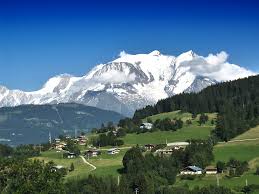
 Mont Blanc (French) or Monte Bianco (Italian), both meaning “White Mountain”, is the highest mountain in the Alps and Europe. It towers 15,781 ft (4,810 m) above sea level and is also sometimes known as La Dame blanche (French for “the White Lady”) or Il Bianco (Italian for “the White One”).
The mountain is part of a mountain range called the Graian Alps, which lies between the Aosta Valley in Italy and the Haute-Savoie of France. The summit lies on a line between the valleys of Ferret and Veny in Italy and the valleys of Montjoie and Arves in France. The three towns and their communes which surround Mont Blanc are Courmayeur in Aosta Valley, Italy, and St Gervais les Bains and Chamonix in Haute-Savoie, France — the latter being the site of the first Winter Olympics. A cable car crosses the mountain range from Courmayeur to Chamonix, through the Col du Geant. The Mont Blanc Tunnel, which was begun in 1957 and completed in 1965, is 7.25 miles (11.6 km) long and runs beneath the mountain between these two countries as one of the major trans-Alpine transport routes.
The first recorded ascent of Mont Blanc was on 8 August 1786 by Jacques Balmat and a doctor, Michel Paccard. This climb was precipitated by Horace Benedict de Saussure, who offered a reward for a successful ascent, effectively marking the start of modern mountaineering. The first woman to reach the summit was Marie Paradis in 1808.
Currently, the summit is ascended by about 20,000 mountaineering tourists each year and could be considered a relatively easy, yet long, ascent for someone who is well trained and is used to the altitude. This belief is reinforced by the fact that from l’Aiguille du Midi (which is where the cable car stops), Mont Blanc seems deceptively close, being merely 3,300 ft (1,000 m) higher. While seeming even closer, La Voie des 3 Monts route (which is more technical and challenging) requires a great deal of climbing and descent before the final section of the climb is reached. However, every year the Mont Blanc massif claims its fair share of victims, and at peak weekends, which is often in August, the local rescue service flies an average of 12 missions, to save people in trouble on one of the normal mountain routes.
There has been some debate and controversy about just who owns the summit since the French Revolution! Prior to the revolution the entire mountain was part of the Duchy of Savoy and then from 1723, part of the Kingdom of Sardinia. However, after Napoleon defeated Italy, Piedmont was forced to cede both Savoy and Nice to France under the Treaty of Paris. But after the Napoleonic Wars and French occupation, the King of Sardinia was restored to his traditional territories of Savoy, Piedmont and Nice under the Congress of Vienna, rendering the Treaty of Paris invalid. 45 years on and a new act was signed in Turin on 24 March 1860 and again on 7 March 1861 by Napoleon III and Victor Emmanuel II, with the consent of the King of Sardinia, which locates Mont Blanc on the French border. This act is still technically valid.
The Mont Blanc massif is currently being suggested as a World Heritage Site because of its unique cultural importance and the fact that it is one of the most visited tourist attractions in the world. It would require the governments of Italy, France and Switzerland to all make a request to UNESCO for it to be listed as one. A piece of splendid trivia for you: in 2007, Europe’s highest toilets, two of them, were helicoptered to the top of Mont Blanc at a height of 13,976 ft (4,260 m). The facilities will service 30,000 skiers and hikers a year, and these toilets currently (and for the foreseeable future) have to be emptied by helicopter – a somewhat challenging yet magnificent way to keep the mountain clean – Mont Blanc, not Mont Noir!

 Caro Field Author
Nice post! I’m always happy to read about nature. I would not want to have the job of flying the helicopter and emptying those two toilets! I enjoyed your writing style and will be checking out your other posts, thanks for teaching me something new.
diaryoflaura20.blogspot.com
Thanks Laura. I will be sure to come and check out your blog too!