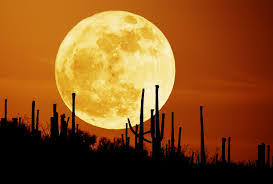
 After writing my non-fiction piece about our sun, I decided to do the same for our moon.
The Moon is the Earth’s only natural satellite and the 5th largest satellite in the solar system. The Moon rotates in complete synchronicity with the Earth and is the brightest object in the sky after the Sun, although its surface is actually very dark, somewhat like coal. Its prominence in the sky and its regular cycle have, since ancient times, made the Moon an important cultural influence on mythology, calendars, culture and the Arts in general. The Moon’s gravitational influence produces the tidal movement of the world’s oceans and the minutes of the day. The Moon’s current orbital distance, about thirty times the diameter of the Earth, causes it to appear almost the same size in the sky as the Sun, allowing it to cover the Sun almost completely during a total eclipse. This matching of apparent visual size is a coincidence. The Moon’s linear distance from the Earth is currently increasing at a rate of 3.82 plus or minus 0.07cm per year, but this rate isn’t ever constant.
The Moon is thought to have formed nearly 4.5 billion years ago, not long after the Earth. The current hypothesis for its origin is that the Moon formed from the debris left over after a giant, cataclysmic impact between Earth and some body the size of Mars known as Theia. It is thought that the pieces of the Earth that were thrown into space as a result, fused to form the Moon.
In 2001, a team at the Carnegie Institute of Washington confirmed that the most precise measurement of the isotopic signatures of lunar rocks showed that the rocks collected on the Apollo programme carried an isotopic signature that was identical with rocks from Earth, and were different from almost all other bodies in the Solar System. Since most of the material that went into orbit to form the Moon was originally thought to have come from Theia, this observation was unexpected to say the least. In 2007, researchers from the California Institute of Technology announced that there was less than a 1% chance that Theia and Earth had identical isotopic signatures. Published in 2012, an analysis of titanium isotopes in Apollo lunar samples showed that the Moon has the same composition as the Earth, which is in diametric conflict with the notion that the Moon formed far from Earth’s orbit or from Theia and supports the hypothesis that it was formed from early bits of the Earth fusing together.
The Moon is the only celestial body other than the Earth on which man has set foot. The USSR’s Luna programme was the first to reach the Moon with unmanned spacecraft in 1959; the United States’ NASA Apollo programme has achieved the only manned missions to date, beginning with the first manned lunar orbiting mission by Apollo 8 in 1968, and six manned lunar landings between 1969 and 1972, with the first being Apollo 11. These missions have returned over 380 kg of lunar rock, which has been used to develop a geological understanding of the Moon’s origins, the formation of its internal structure, and its provenance..
After the Apollo 17 mission in 1972, the Moon has been visited only by unmanned spacecraft. Future manned missions to the Moon have been planned, including government as well as privately funded efforts. The Moon remains, under the Outer Space Theory, free to all nations to explore for peaceful purposes.
The dark and relatively featureless lunar plains which can clearly be seen with the naked eye are called maria (Latin for “seas”; the singular word being mare), since they were believed by ancient astronomers to be filled with water. They are now known to be vast solidified pools of ancient lava – basaltic lava. While similar to terrestrial basalts, the mare basalts have a far higher percentage of iron and are completely lacking in minerals altered by water. Maria are found almost exclusively on the near side of the Moon, covering 31% of the surface on the near side, compared with a few scattered patches on the far side. This is thought to be due to a concentration of elements that produce heat under the crust on the near side, which would have caused the underlying mantle to heat up, partially melt, rise to the surface and erupt. So most of the Moon’s mare erupted during the Imbrian period, 3 – 3.5 billion years ago, although some radiometrically dated samples are as old as 4.2 billion years and the youngest eruptions appear to have been only 1.2 billion years ago.
The lighter-coloured regions of the Moon are called terrae, or more commonly highlands, since they are higher than most maria. They have been radiometrically dated as forming 4.4 billion years ago. In contrast to the Earth, no major lunar mountains are believed to have formed as a result of tectonic events. The concentration of mare on the Near Side is probably due to the fact that the substantially thicker crust of the highlands of the Far Side may have formed in a slow-velocity impact of a second terran moon a few tens of millions of years after the formations of the moons themselves. The Moon’s surface is also studded with craters formed when asteroids and comets collide with the lunar surface. There are estimated to be roughly 300,000 craters wider than 1 km on the Moon’s near side alone.Some of these are called after scholars, scientists, artists and explorers.
Finally, liquid water cannot exist on the lunar surface. When exposed to solar radiation, water quickly decomposes and is lost to space. However since the 1960s, scientists have hypothesized that water ice may be deposited by impacting comets or possibly produced by the reaction of oxygen-rich lunar rocks, and hydrogen from solar wind, leaving traces of water which could possibly survive in cold, permanently shadowed craters at either pole on the Moon. Computer simulations suggest that up to 14,000 km2 of the surface may be in permanent shadow. In years since, signatures of water have been found to exist on the lunar surface. The presence of usable quantities of water on the Moon is an important factor in assessing whether it would be possible to live on it, since the cost of transporting water from Earth would be prohibitively expensive. But the question is, would anyone really want to, given the fact that on the Moon we could not enjoy the extraordinary beauty that our Earth possesses and its wonderfully diverse vegetation and animal life?
 Caro Field Author
Looks like you went over the moon on this…
I did
For a time, colonizing the moon probably will be left to scientists, researchers and those adventurous people who delight in doing the unusual or the new.
That said, I think that wherever humans go, they will bring their old lives with them in some form. As the colonists from Europe carried plants and animals they used daily or simply enjoyed and propagated them (until many have become invasive pests), when (and if) we go to the moon en masse, the cities that are built will be filled with pieces of Earth.
And it’s a different kind of beauty as well. Because the moon is smaller, we don’t have the amazing Earth-rises that a person living on the moon would be able to enjoy. Mars and Venus will both appear larger and more dramatic when the alignments are right.
It will be its own place with it own virtues and flaws.
An interesting view! I am afraid that the beauty of this planet often leaves me speechless and I find it hard to imagine how I could or would appreciate a planet/star that was more sterile.,,
The beauty on this planet is beyond amazing. I would miss Earth if I went, but I suspect there are many who would still go happily. Just as people who first traveled across the oceans missed their homes.
It doesn’t mean they didn’t appreciate their new homes; they just saw different things to appreciate. A lot will change on this planet in the time it will take to design and construct a habitable moon settlement… Who is to say that the moon won’t be more appealing by then?
(Nice article,…as you probably can guess I liked it 🙂 )
Yes, I agree with all you say. And, given how much we have managed to trash our planet, due to our own stupidity, there may be no alternative in the end…I am glad you enjoyed the post!