
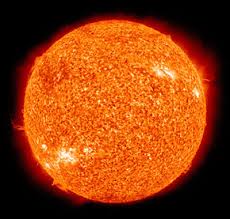
 The Sun is the largest star in our solar system, accounting for 99.86% of the total mass of the solar system. To give you an idea of its size, it has a diameter about 109 times the size of the Earth at about 865,600 miles (1,392,684 km) wide and a mass about 330,000 times greater. Chemically, about three quarters of its mass is hydrogen, the rest mainly helium. The remainder (just under 2% of it), is made up of heavier elements like oxygen, carbon, neon and iron. This 1.69% still represents a mass 5,628 times that of the Earth.
The core of the Sun rotates as a single body but the outer layers of the Sun rotate at different speeds; so while the surface at the equator rotates once every 25.4 days, the surface at the poles only rotates every 36 days. This strange behaviour is due to the fact that, unlike the Earth, the Sun isn’t a solid body. At the Sun’s core, the temperature is a staggering 15.6 million Kelvin (K). It’s power is produced because each second about 700,000,000 tons of hydrogen is converted, via nuclear fusion, into approximately 65,000,000 tons of helium and 5,000,000 tons of energy in the form of gamma rays. As it approaches the Sun’s surface, the energy is repeatedly absorbed and then re-emitted at ever lower temperatures so that when it reaches the surface, known as the photosphere, it is primarily visible light at a heat of 5800 K. Above the photosphere is a small area known as the chromosphere, and above that is the corona, which is highly rarefied, the temperature being 1,000,000 K, but which extends millions of kilometers out into space, although it is only seen during a total eclipse.
 From the Earth, our Sun and Moon appear the same size, though of course, they are not. Since the Moon’s orbit roughly echoes the Earth’s orbit, there are times when the Moon moves directly between the Earth and the Sun. When this happens, the entire solar disk being blocked, we get total eclipse. If the alignment is less than perfect, we get partial eclipse. Partial eclipses are visible over a wide area of the Earth, but the region from which a total eclipse is visible, known as the path of totality, is extremely narrow, only a few kilometers wide. You are likely to see a partial eclipse from anywhere in the world maybe a couple of times in a decade. However, the chances of seeing a total eclipse are minimal, unless you are prepared to travel halfway around the world to be in the path of totality. But it is worth it. To stand in the shadow of the moon is an awe-inspiring experience. For a mere few minutes, it is dark in the middle of the day, the stars come out, birds and animals fall silent, thinking it’s time to sleep, and the solar corona becomes visible. Magnificent!
The Sun’s magnetic field is immensely powerful, extending out into the Solar System, way beyond Pluto. As well as heat and light, the Sun emits a low density stream of charged particles known as the solar wind. These electrons and protons move through the solar system at a speed of 279.6 miles/450 km per second and can have an effect on Earth ranging from power line surges to radio interference, from the trajectories of space craft to the Northern Lights or Aurora Borealis.
Recent research from the space craft Ulysses indicates that when the solar cycle is at its lowest, the solar wind in the polar regions moves almost twice as fast at 466 miles/750 km per second.
The Sun is about 4.5 billion years old and, since its inception, has used up about half of the hydrogen at its core. It will continue to radiate for another 5 billion years, during which time its luminosity will probably double. However, it will eventually run out of hydrogen to fuel it and when it does, it will result in the total annihilation of the Earth, if our own stupidity at rubbishing our planet has not already caused this.
 Caro Field Author
This says it all “if our own stupidity at rubbishing our planet has not already caused this.” I fully expect us to ruin the planet far before the sun ceases to shine. Lots of great info. I didn’t know about the Path of Totality. It sounds like the way we should live our lives taking the Path of Totality. Hum.
I love this kind of science…this blog was fascinating to write…
Hmm. What made you deign to shed light on this subject? And, without a poem?
Great info, though!!!
Just decided it would be an interesting subject tio research and I fancied writing non-fiction for a change…
Well, aren’t you just a ray of sunshine today. Very interesting Caro. Now you just need a poem to go along with it!
…I will think about doing one…
Wonderfully informative post. I learned quite a bit about the sun from you. I agree with Ann. I think we will set our demise in motion before the sun runs out of fuel. Fascinating post – thank you!
I know, sad thought, huh?
5 billion years hence. It’s hard to even fathom. Wonderful food for thought!
Amazing science, huh?
This a very interesting post. It brings me back to my high school dzys. Great post.
Thank you Charles!
Do you think that there are other suns elsewhere? I sometimes wonder. Maybe, once the sun has used all its hydrogen we could all go to a different galaxy?
I’ve sometimes speculated in that too! Trouble is, I think we’d be hard pushed to find a planet as beautiful as the Earth.,,