
Since the rather wonderfully named Waterlooville, here in South England is currently under inches of snow, I thought I would write a blog about it!
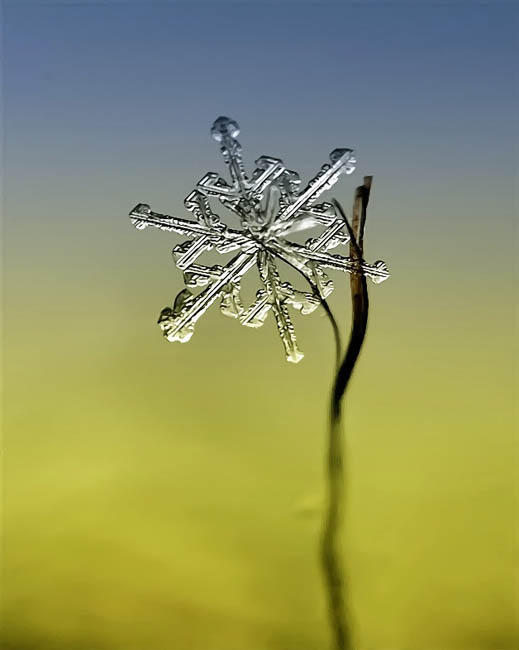
A snowflake can be either a single ice crystal, two of them fused together, or a whole mass of them getting together to have a party, to make a kind of snowflake puff ball. Snowflakes are not frozen raindrops, that would be sleet. Instead they are crystals which form when water vapour condenses straight into ice in the clouds. The unique shape and pattern of each snow flake gradually emerges as the crystals grow.
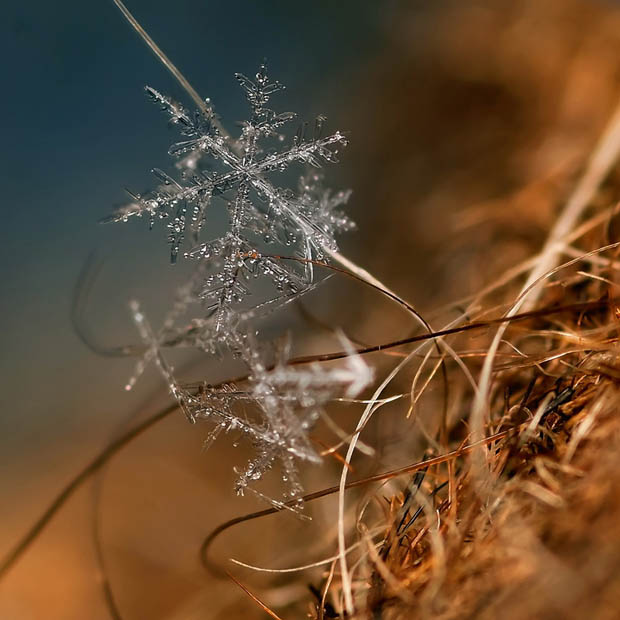
A snow crystal, that may be round, will attract material to it, because it is rough, but then there may also be a number of facets that are smoother and so accumulate material much more slowly. After all the rough surfaces have grown out, only the slower-growing facet surfaces remain, to create the snowflake. A snowflake is, most commonly, a hexagonal prism in shape. This, in turn can either be plate-like (or flat), or columnar, depending on which facet surfaces grow the quickest.
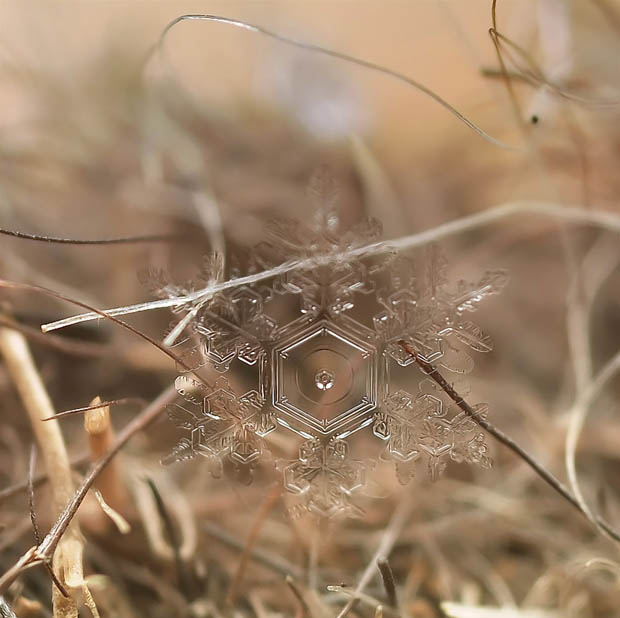 When snow flakes are just baby flakes, they tend to just be these hexagonal prisms, but as they mature and grow, branches grow out from the corners to create more intricate and complex shapes. This perfection, is, like so many things in this world, created from imperfection. Snowflake branching occurs because in order for water vapour to attach to the ice crystal, it has to diffuse through the air. If it finds a spot on the crystal with a tiny protuberance, it does not have to travel so far through the air to condense, so it tends to concentrate itself around and grow quicker at that particular spot…creating a branch. Then that branch in turn may have minor imperfections, so the process repeats itself. The result is an exquisite structure…unique to itself, because no two ice crystals will have lumps and bumps in the same spot. Cool physics, huh?
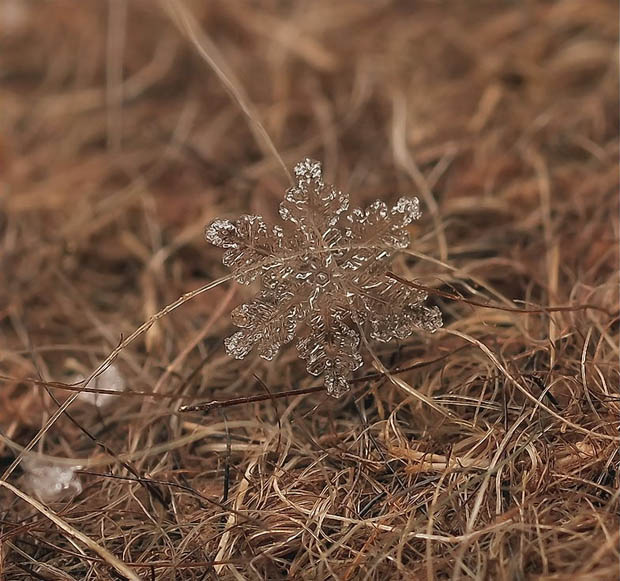
Now for more interesting science! Thin plates and starlike flakes tend to develop at temperatures of -2º C (28 F) and -15º C (5º F),columns and needles at around -5º C (23º F) and a combination of plates and columns at about -30º C (22º F). Also snow crystals tend to form simpler shapes when the humidity is low, and more elaborate ones as the humidity rises.
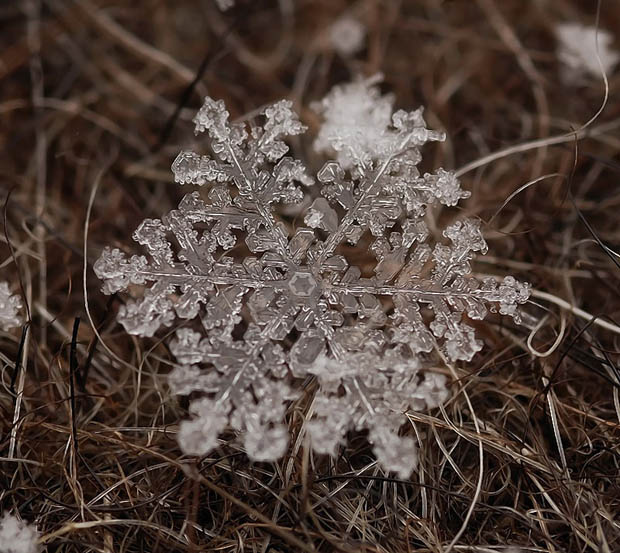
So the life of a snowflake entails evaporation of the water vapour from seas, lakes, rivers, plants, even you, when you exhale! If you take that air and cool it down, it will eventually condense, as dew if it is near the ground, as snow, if it is way up high.Snow-forming clouds are just conglomerations of liquid water droplets, until the temperature drops to about -10º C (14º F) and then the droplets gradually start to freeze, as described above.
So the next time it snows, consider the complicated evolution of that single snowflake that lands on your hand!
 Caro Field Author
Too bad their unique designs can’t be more easily seen. All that complicated creation and to miss the results is kind of sad….
I know! But it IS rather wondrous isn’t it?
Beautiful photos and lovely post.
They are beautiful photos aren’t they?
I don’t know how the photos were taken, but they are stunning. how beautiful our world is at all levels.
They are stunning photos, huh? Macro photography by the Russian photographer Andrei Osokhin
Very interesting!!!! Glad you shared.
Thank you!
Caro- you never disappoint! That video is just spell-binding. The images you’ve included are all the more breathtaking knowing all of the complexities involved. My favorite line… “This perfection, is, like so many things in this world, created from imperfection.”… What a lovely reminder of the beauty in our world and the way all of nature, including us… is able to create perfection from imperfection. Lovely start to the weekend.
Thanks so much Kathi!! Stunning images,huh? Taken with a macro lens by a Russian photographer….
Fabulous post! Love the photos Rosemary
Beautiful, aren’t they? I wish I could take credit!
Absolutely breathtaking photos, Caro! I will certainly share this.
Glad you enjoyed it and thanks for sharing!
Beautiful photos and post Caro! We get a lot of snow here in the high desert area of So. Oregon.
Thank you so much Victoria! Glad you liked it!
Caro, what beautiful pictures of snowflakes! What awesome handy-work straight from nature! We got a few of those today. 🙂
Thank you! They are stunning aren’t they? The work of a Russian photographer….
I’ve always been fascinated with snowflakes. Like people you can’t always see how beautiful they are until you look closer.
Diana
They are extraordinary and exceptionally beautiful and as you say, like people, unique…
They are indeed! Like people, unique…