
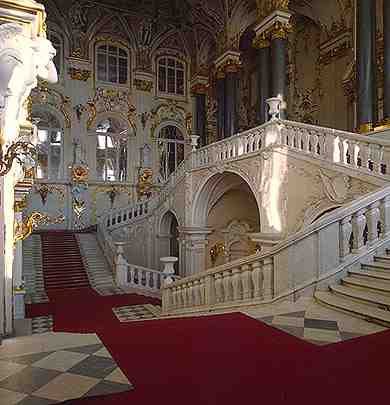
One of the most famous spaces in the Small Hermitage in the Winter Palace in St. Petersburg is the Pavilion Room (Catherine the Great’s dining room). You approach it via a huge flight of stairs, The Jordan Staircase. This was clearly designed to intimidate, and to overawe. It sweeps up extravagantly to the next floor in two directions, creating a natural stage at the top.
The Pavilion Room was designed by one of the most famous 19th century Russian architects, Andrei Stakenchneider. It has a colonnade of marble columns, supporting a gallery above that is graceful and elegant. On the floor is a copy of the floor mosaics that were unearthed at the roman baths at Ocriculum. There are four fountains, one at each corner of the room, picked out in a deep red marble and a staircase leads up to the gallery above.
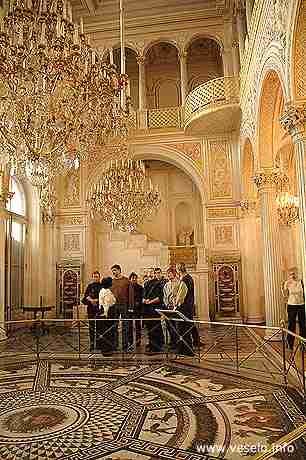
As you walk in, to the left, through huge, floor to ceiling, plain glass windows, is a wonderful view of the river Neva and the golden spire of the Peter Paul fortress on Hare Island beyond.

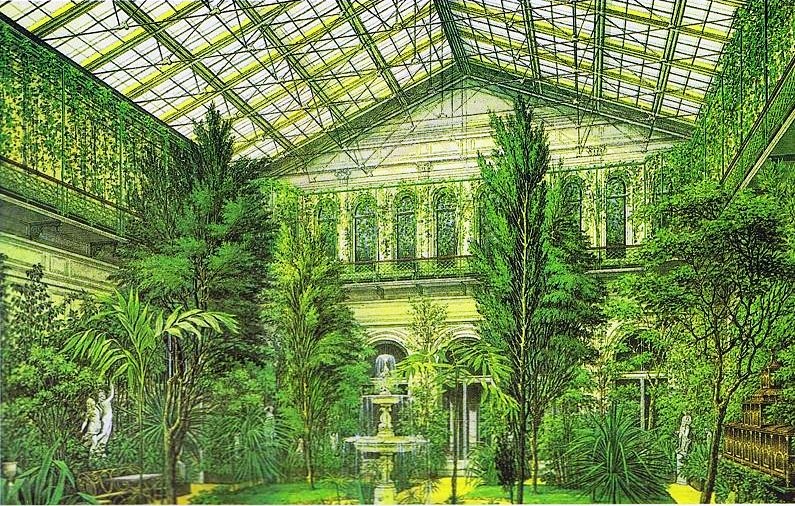
To the right is the winter garden a beautiful Italianate garden up on the first floor…In bygone years it was a gigantic glasshouse.
But the most famous feature of this room is the Peacock Clock, a ten foot high automaton. It was commissioned by Potiemkin and designed for Catherine the Great. Made in 1781 by James Cox, a London jeweller and goldsmith, it was brought to Russia in pieces and took 9 years to put back together again! But it was worth the wait. The clock features a gilded copper peacock on a branch, a rooster and an owl. On the hour, a moving cage rotates around the owl with a peal of tinkling bells. The owl’s head swivels and it opens and closes its eyes. The peacock lifts its beak, stretches its neck and opens it’s tail feathers with a flourish. It circles round to face the Neva, then circles back and lowers it’s plumage. The rooster crows. It is still in working order, although I am told that the museum only winds the clock for the White Nights Festival now, in order to preserve the mechanisms that drive the clock. Numerous features adorn the clock such as a squirrel eating a nut, and a dragonfly that acts as the second hand on the clock dial, which is on the head of a mushroom.
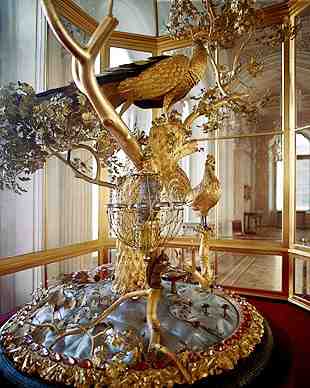
This was never intended to show the time or to be a hugely accurate timepiece. This clock was made purely to impress. And it does. It is exquisite. Magical. Unique.
 Caro Field Author
Thanks for liking it!
It’s on my list of places I MUST visit – even more now, with these photos!
It is truly wonderful, huh? I urge you to go – it is one of the most beautiful cities in the world…:)
Magical indeed! I love the orangery image. Ever time I see one, I fall in love, again and again…
Thank you! Beautiful, huh?
Reblogged this on A Garden of Delights and commented:
Lots of people post buckets lists–here’s a list of dreams I have from time to time–Caro must have read my mind.
How wonderful Eden!