• About Caro Ness

Caro Field Author

~ Thoughts and musings and poetry

Caro Field Author

Category Archives: Uncategorized

Aside

IN MEMORIAM MARK ORME

31 Wednesday Oct 2012

Posted by Caro Field in Uncategorized

≈ Leave a comment

This was written to Sarah, Mark’s wife.
Mark put himself through endless treatments because he was determined to live, but he also told me the following:
He said that he came to Leonardis for treatment and had tried all sorts of other treatments in order to cling on to life like no tomorrow and for as long as he possibly could. But he also said that ultimately he knew that the illness would probably take him. So he was determined that death would not beat him. That he would stay as fully in the present as he possibly could so he did not ever regret wasting a single second of it, of what life had in store for him. He said he wanted to savour every second of his time with you and the kids and he would. Fully. No looking back because the past was gone and that there was no room for any regrets or recriminations, no looking forward because there was no point in second guessing what was to happen in the future. That the only time of which he or anyone could be certain was NOW. So NOW is where he always wanted to be. And where anyone who knew him would always find him.
I do not need to tell you that your husband was an extraordinary man. I admired him more than I can say.

DEATH

30 Tuesday Oct 2012

Posted by Caro Field in Uncategorized

≈ Leave a comment

Why is it that death so defeats us? Sometimes it comes with foreknowledge, sometimes like a thief in the night. It is always unwelcome. Yet it comes to every one of us. We know it is there, lurking, waiting, but are always unprepared for it.

Grief is a strange bedfellow. It takes us all in different ways. Common to all of us though, is that need to see ourselves as immortal, including those we love. When we are not, it is a devastating blow. One that every one of us struggles to come to terms with.

For those of us who have an illness that may well kill us, we have tried to prepare ourselves to some degree. This, of course, is ridiculous. Although we may say that we don’t fear death for ourselves, it simply isn’t true. We have not yet had to confront it. We have not yet faced the grim reality of it. For those for whom death is imminent the struggle to deal with it is harder still. Many choose to shut themselves away for a while. They need to mourn their own death before they can allow those they love in,  those who are, in turn, mourning their imminent loss.

One of my friends, Mark, knew he was dying, but he had already made peace with himself. The consequence was that he then lived more fully in the moment than anyone else I have ever known. He told us that he knew he was going to die so he did not want to waste a single minute. And he didn’t. He lived, joyfully, until the day he died.

When I die I hope I have the courage to go the way Mark did. Living life to the full, filling every moment, making peace with myself, my world and my place in it, until the last breath leaves my body.

YOU KNOW WHO YOU ARE

29 Monday Oct 2012

Posted by Caro Field in Uncategorized

≈ Leave a comment

Another wee excerpt cuckooed from a forthcoming novel….

I throw myself back on the bed. My arms over my head. I stare at the ceiling and grin. I have been trying to read the signs in each message. Subtle nuances in each texted word. I’ve felt you holding yourself back a little. Sensed that you need to test my resolve. I’ve wondered, on occasion, whether you trust yourself or indeed, whether you trust me.  Till now. Till tonight. Tonight, for the first time, you have declared yourself. A wonderful woman has told me that she loves me too. You have told me you love me.

I am content, I am complete, I am the Cheshire Cat, I am a smile.  I feel the physicality of our relationship, I love the visceral pull of it. In your company, my heart feels really present in my chest. It beats with savagery, abandon, tenderness, release. Talk to you and the urge is deep, a ribbon of fire from heart to groin. Spar with you and the space between my shoulders expands to drink the laughter in.  A tuning fork, vibrating gently, body and mind hum to a single tune. Every note they play is you.

You hate to feel crowded. Hate to feel pressured. Loathe relentlessness. But oh, I want you to feel my want of you. I want to feel your want of me.  The world is a far, far better place because it has YOU in it.  Speaking with you is like strawberries and cream, like fireworks exploding on a dark, dark night. I want to be part of your world and for you to be part of mine.

Have you any idea how central you are to my life my darling? That with your support, I have begun the process of transformation, of regeneration,? And that you have saved me from myself? I think of you and I am alive to a future of infinite possibility, of probability, of certainty, of choice. I have never been lucky. With you I am. With you in my world there is nothing I cannot do. With you at my side, I feel brave again. There is nothing I would not do for you, my love, and I cannot help thinking that one day, together, we will be invincible….

OUR WONDERFUL MOTHER

29 Monday Oct 2012

Posted by Caro Field in Uncategorized

≈ Leave a comment

I have been meaning to write this piece for a very long time. Only now do I have the equanimity to do so…

Our mother became profoundly deaf. She could not even hear us if we stood beside her because so much of her hearing was done by lip-reading. But our mother was also an incredibly sociable person, she loved people and they loved her. She engaged with everyone and they with her. People trusted her implicitly. They found themselves telling our mother the most impossible, intimate secrets. They told her things that they didn’t even tell their own mothers with equanimity and in complete trust. They had it. She was one of the most discreet people I’ve ever met. She always made us feel as if we had her full attention. And, indeed, she always gave it.

She was the kind of person who everyone gravitates towards. The kind of woman who you know has walked into a room because the atmosphere changes subtly for the better. And also because she was beautiful and immensely elegant.  Yet there was nothing flashy about our mother. She was very humble. Very self deprecating. She never lost her temper, yet we always knew instantly if she disapproved of something. She was a great cook, a great provider. Everyone felt special in her company.

She had had polio in her 20s. She had no muscle in one of her legs at all, except for the muscle from her other big toe which was transplanted behind her knee by an American surgeon. This was so she could flex her leg to walk. And she did. Miles. Every day. With the dogs. She got tired easily and was in pain a lot but she never complained. Never.  Regardless of circumstance, our mother always remained loving and sweet-natured.

She was disabled because of the polio, but for her, it was the deafness that was crippling. She wanted to join in but often couldn’t. She loved parties, but, although she would not admit it, simultaneously semi-dreaded them. All she ever heard at them was babble, a horrendous version of white noise.  She always said that if she had the choice of deafness or blindness, she would have chosen to go blind. She said she still had the memory of what the world was like, of what we were like.  But for her, not being able to be part of it was torture. It was the cruelest form of isolation in the midst of a busy, sociable world she longed to feel fully part of.

We urged her to have a cochlea implant because, it seemed, she was a good candidate. She procrastinated. We did not know why. Eventually, she had one.  For her, it was a steep learning curve, mastering the signals that were flooding her brain. For us, it was a miracle. For the first time in years we could talk to her on the phone, rather than relay messages through our father. For the first time in ages she could listen to music, her joy, and love it once again. Our mother was returned to us, fully.

And then she got a cold. A stinker. It lingered and worsened.  And we learned why, perhaps, she had taken so long to decide to have that implant. It seemed she had an illness buried deep within her that would only come to the surface if provoked. Myleofibrosis. It is a form of leukaemia that inhibits the bone marrow’s ability to create new blood cells. The spleen enlarges hugely because it is trying to do so instead.

Our mother soon had puffy, elephantine legs. Yet she was birdlike from the waist up because she had no space in her stomach to eat. The pain this caused her became intolerable. And our proud, elegant, lovely mother simply hated it. Hated the loss of her independence. Loathed the fact she could not walk much any more. Particularly after the trials she had faced earlier in life, and that, by force of will, had overcome. Did not want other people to do for her what she had so willingly, cheerfully done for them.

So our mother chose to die. I did not mention that she was also vey single-minded. When our mother decided to do something, it always got done. Our mother, with characteristic bravery, sat down with our father, and wrote a letter to each of their friends. She told them she was dying. She told them she did not want them to read about her death in a newspaper. She told them that she loved them.

She made herself a pact. She did not want to see any of her grandchildren, whom she adored, because she wanted them to remember her with vitality and joie de vivre. But she did want to say goodbye to each of her children. So we came, my brother and I from different parts of England, my sisters from Africa and Australia, respectively. We came to spend time with this extraordinary soul. To laugh with her. To reminisce. To love her unconditionally, as she did us.

She said goodbye to each of us in turn. Our brother was the last to say farewell. She died the night after he came to see her. She died where she wanted to. Where she should have done. She died in the place that she had made a safe haven for all of us. She died at home, in her own bed.

The night our mother died was extraordinary. You can read what happened in my poem, Our Mother’s Goodbye.
Pushing Seeds

23 Tuesday Oct 2012

Posted by Caro Field in Uncategorized

≈ Leave a comment

I went to a meeting yesterday and afterward, I sat and talked to my boss about the past. This is his story of his great grandfather…

Bow, like the rest of London,lay in the grip of smallpox… Archie, aged 6, got up to do his usual job of waking the butcher at 5.30 so he could get the shop ready for his customers.  This morning, he felt unwell. His head felt as if someone was repeatedly jumping on it, and his bones, no his whole body,  ached. Fishing in his pocket for a handkerchief, to wipe the end of his nose, he set off at a trot up Spanby Road, then turned into Swaton, crossed Rounton and ended up in Campbell. The butcher’s house was number 47. He knocked repeatedly, until the window shot open and Mr Babbage, shouted,”Enough!” at him, then turned tail and scooted home again. When he got there,he was dripping sweat, and appeared to be running a fever. His pa, the only other family member up at that time, took one look at him and said ‘Off to Sawbones with you!” So he duly trotted around the corner to Dr Ketson in Fern Street.

The doctor took one look at Archie who, by now, had a face like a lightly cooked beetroot, and pointing  in the direction of the river,  said gruffly ‘To the boats with you!” Archie’s heart sank. He stopped jogging, and  slowing down, almost dragged himself  south, in the direction of the Thames, towards West India Dock.   Once there, he went to the nearest muster point.

There was a River Ambulance lighter, bobbing in the bracken water. It was tied to a stanchion onshore and people were being hustled onto the vessel. He joined them. The small boat was punted out into the river by the helmsman, who wore a mask which covered his face, all but his eyes. Once away from the shore,   they all knew where they were headed, to the two old wooden warships and one iron paddle steamer, moored off Long Reach, a little way from London Bridge,  in the middle of the river. They had  been moored at Deptford Creek, near Greenwich, but the Commission had decided to move them here in1881. The  Atlas carried  male patients, both the acute cases and those others less ill who had caught the dreaded disease, the Castalia  was for female patients.  The Endymion was used for administration and stores. This was London’s logical solution to keeping those slowly decaying and dying away from the rest of the populace… in the middle of the river on boats.

Once close, Archie was shunted up onto the Atlas. He was small for his age, and scared. He knew no one and none knew him. He acclimatised…  On close inspection, the Atlas appeared to be made up of  four decks of patients; the main, lower and orlop decks and what appeared to be an isolation ward on the upper. He wandered where he could. He also came across the dispensary and the sleeping quarters for all the medical staff on board and a strange, rather complicated gangway that tethered the boats together in a line. It allowed for the rise and fall of the tide and the lateral movement of the vessels.

Archie soon worked out that new arrivals were delivered to reception rooms on the orlop deck and then taken in a lift to the upper deck if necessary. Being small and insignificant, Archie was not one of them, he was simply overlooked. The air was poor, because the only windows were the old gun ports, and the ceilings were far too low so  the boat proved  cramped, unforgiving,  airless. He melted into the fabric of the ship. No one seemed to notice him until one day a medical orderly thrust a brush in his hand and said, ‘If you are still on your feet mate, you have to earn your keep. Sweep!” So Archie swept. From morning till night, from the top of the ship to the bottom and back, only stopping for meals.These were brought over from the kitchens on the Endymion.

He swept the sloughing flesh of the smallpox patients, that sheered from their faces, their limbs, their bodies, leaving tell-tale craters.  The skin fell like small, imperfect coins on to the deck…When he brushed they rustled and he could smell the rot. When he brushed he half-closed his eyes and thought of his mother. With each forward stroke he gathered up more and yet more ‘seeds’ and swept them over the side into the water below…

The Road to Crowcombe

22 Monday Oct 2012

Posted by Caro Field in Prose, Uncategorized

≈ 2 Comments

Tags

Crowcombe, somerset, The Road to Crowcombe

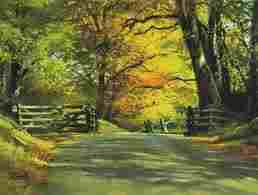
If you follow the road to Crowcombe through Over Stowey, in the summer months, you cross a cattle grid, then the road climbs uphill, winding gently through ancient forests…Coppices of burr oak on either side of the road  are interspersed with beech and indeterminate vegetation.  In places, the branches corkscrew and unfurl across the road and embrace overhead in a soothing green canopy. The road meanders lazily upward then suddenly bursts out onto open moorland.This is not Exmoor, but it feels like it. Gorse bushes, reeds, heather, low patches of nettle and banks of campion. Fritillary hover, dip to the brightest of flowers, to sip the nectar, then stop on lantana to spread their wings.  There is a remoteness, a ruggedness, a wildness and yet a deep tranquility on the sharp, clear air. Sheep, grazing on the moorland, wander across the road in front of you, and often lie on it, to catch the latent heat…wild ponies skitter across the road in a flurry of hooves and flaring nostrils.

Look out across the moor to your left and softly rounded, farmed land and ridges are visible beyond the woods, on which cattle graze and the odd red deer, escape bravely, tiptoeing hesitantly from the safety of the woods. Bear right and the coastal views simply take your breath away. Deeply incised wooded valleys drop directly into the sea, the cliffs are rugged, forbidding, streams drop sharply through deep green undergrowth…and there in the distance, across the Bristol Channel is the Welsh shoreline, barely visible in the dappled, dimpsy light…

Further around, in the Channel, closer to the coast, the islands of Steepholm and Flatholm thrust out of the waves, and stretch out, apparently lazily, in the waters, respectively. Then look left, and follow the coast until you reach the steep, rugged cliffs at Linton and Linmouth, and the thin stripe of sand that marks Minehead. Further around still, the rolling land that is Exmoor,stretches itself out beneath you as far as you can see. And if you are fortunate, you may catch a buzzard spiralling upward and gliding down on the late June air…

Reach the top, before plunging down the precipitous road to Crowcombe itself, with its overgrown emergency exit lane. Look up to the left and the leafy bridle and pathway meanders upward toward Crowcombe Gate and the trig point at Triscombe Stone. This is what it is to be in God’s own country…

CROWCOMBE PARK GATE

22 Monday Oct 2012

Posted by Caro Field in Uncategorized

≈ Leave a comment

The glory of Somerset walks…

published by kind permission of the artist, Barry Watkin

Newer posts →

A Four Letter Word – Buy Here

My Facebook Page

My Facebook Page

Enter your email address to follow this blog and receive notifications of new posts by email.

Join 1,534 other subscribers

Gallery

This slideshow requires JavaScript.

Blog Stats

  • 97,644 hits

Tags

artwork barcelona beach bear bend boat books brazil bridge butterfly canal caravan cars cats celebrity chef child chimes china Crowcombe desert dogs drinks eca embellishment equestrian fame flowers France friendship green guitar handbags happiness home Italy Japan joy lavender London love map music nature O P poetry puddings rain rainbow river rivers rosd salmon sand sea ships shoes shopping sky sleigh snow somerset spain stardom statue sunrise sunset The Road to Crowcombe trees walk walking weather winter world

Blog at WordPress.com.

  • Subscribe Subscribed
    • Caro Field Author
    • Join 409 other subscribers
    • Already have a WordPress.com account? Log in now.
    • Caro Field Author
    • Subscribe Subscribed
    • Sign up
    • Log in
    • Report this content
    • View site in Reader
    • Manage subscriptions
    • Collapse this bar
 

Loading Comments...