• About Caro Ness

Caro Field Author

~ Thoughts and musings and poetry

Caro Field Author

Category Archives: Uncategorized

ZAMBEZI MUD

15 Thursday Nov 2012

Posted by Caro Field in Uncategorized

≈ Leave a comment

 Image

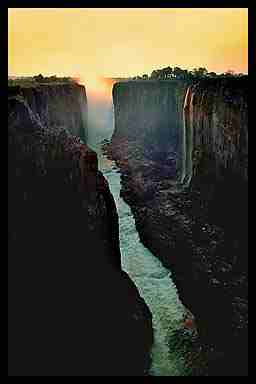
Some years ago, I went white water rafting on the Zambezi. We set off on the Zimbabwean side of the river, from just below the Victoria Falls Hotel. There were six boats in all. Five were huge dinghies, paddled entirely by the guide taking the party down the river. The sixth was a smaller dinghy which had to be self paddled by everyone in the boat.

My friends and I reached for the paddles and took command of the smaller boat. Five of us already knew each other, we had been camping in the bush for ten days.Those five were myself, my husband, Malcolm, our English friend Rob and two Zambian friends, brother and sister, Peter and Jacqui Castle. Apart from our guide, a six-packed, excessively beautiful American called Dan, there were only 2 others in the boat. Two sisters from Medellin, Elizabeth and Consuela.

 Image

We were given the briefest of practices in the calm water near the hotel. There were only 5 principles and they were:

  1. Always hold on to your paddle with both hands
  2. Whatever you are faced with, never stop paddling 
  3. If you do stop paddling, you or someone else will probably fall out
  4. If you do end up in the river, Dan would throw you a line to pull you back to the boat
  5. Oh, and do not stay in any longer than you have to, you are sharing the river with crocodile

So off we went. Rob and Dan were in the front of the boat, because they were a similar size and weight. Then myself and Consuela, then Jacqui and Elizabeth, then Malcolm and Peter in the stern. They were the biggest men, so technically were meant to supply a bit of oomph…

 Image

As we got to the first rapid, the noise of the water was unbelievable… the sound of a typhoon in a wind tunnel… As we got closer we were faced with a stark reality. The water fell away steeply in front of us, a drop of approximately 12 feet. Simultaneously, there was a wall of water that rose about ten feet above our heads. 

Rob froze. He looked as if he had been captured by time lapse photography. His paddle was raised to pull but it stopped in mid-air as he took in the prospect of being sandwiched between two walls of water. I screamed at him to paddle, but to no avail. Those behind me told me that I slid sideways into the water as if in slow motion.

I can only describe what happened next as mind-blowing and terrifying. I was sucked into the middle of the rapid and pulled through it under water at the most incredible speed. All I could hear was a rumble that sounded like thumping static, beating as hard as the adrenaline coursing through my veins.  I could see absolutely nothing at all. I did not even know which way I was facing. Up or down. Forward or back. I was just beginning to really panic when the current threw me up into the fresh air again. I heard a shout from behind me. I turned to see Dan throwing me a long line with astonishing accuracy. I grabbed it and he began to haul me in. The rapid had regurgitated me approximately 150 yards ahead of the boat.

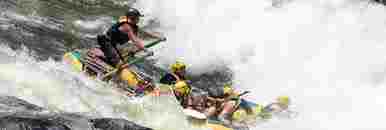
That experience was enough to give me a very healthy respect for the river. I did not want to go in again. From there on in, I ratcheted my voice up several decibels, like a megaphone, and screamed at the others to paddle for all they were worth. And it worked. For the next four runs any way, but at the fifth, we hit a particularly turbulent stretch of water. All of us were thrown around remorselessly, and I felt a clunk on the side of my head, but, more by luck than judgement, we all remained aboard.
 Image

It was hot and my hat was sticking to my head.I was aware of a trickle of sweat running down my cheek. I put my hand up to wipe it away and was puzzled to find that it came back red. It was at that moment, in the middle of the Zambezi river, that Malcolm shouted, “Stop the boat! My wife is bleeding!” 

Clearly this wasn’t an option. We pulled in to the bank to check the damage. The huge bump on the side of my head, black and green eye, and gash across my right cheek were evidence of why you should grasp your paddle in BOTH hands. Consuela had let go with one and had clocked me on the  head with the end of it. I had  an instant headache, visible war wounds, and a bloody T shirt, but was absolutely determined not to change boats, despite numerous people offering to swap with me.

We sailed through 3 more rapids, before anyone went in the water again. This time all of us did. The water was such a relief. Luxurious and cool after hot, hot sun, until we remembered the crocodiles. On another occasion, all of us got out of the boat and climbed round the headland on foot, allowing Dan to bing the boat through a really difficult and dangerous rapid alone. It was astonishing, the boat appeared to surf through the water, with Dan wielding the paddle with nonchalant, but highly studied grace. 

 Image

The rest of the trip was a blur. The climb out of the ravine was exhausting. I had a headache for about a month, a black eye for four, bruises all over my body and I still bear two small scars near my right eye where the paddle hit me. Would I change a thing? Hell, no!
A RUSSIAN PETER PAN

14 Wednesday Nov 2012

Posted by Caro Field in Uncategorized

≈ Leave a comment


For Fima, my Russian Peter Pan because he made St Petersburg a magical, living,  breathing entity for me in every possible way.


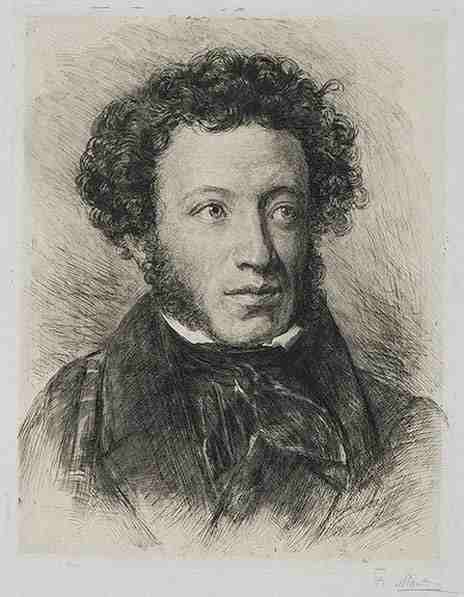
‘Вечером 27 января молодой человек совершил свой последний визит в это место, Литературное кафе, 18 Невском проспекте в Санкт-Петербурге. Молодой человек был Александр Пушкин, который умер через 2 дня от дуэли ранения, полученного в тот вечер в руках Жоржа Дантеса. Eму было всего 38. По сей день, в кафе имеется восковой манекен его в окно, чтобы отметить этот факт. В частности, мы восхищаемся нашими авторами.”


“On the evening of January 27th, a young man made his last visit to this place, the Literary Cafe, 18 Nevsky Prospect, in St. Petersburg. The young man was Alexander Pushkin, who died 2 days later from a duelling wound received that night at the hand of Georges d’Anthes. He was only 38. To this day, the cafe has a wax mannequin of him in the window to commemorate this fact. We particularly revere our authors.” 


Image


Alexander Pushkin


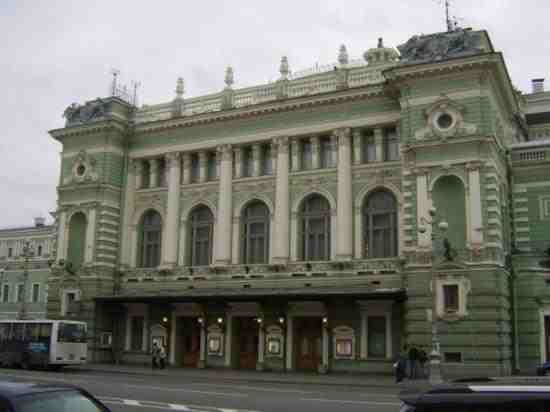
I was a student of Russian and I did my 6 month elective studying and living in St. Petersburg – in those days still called Leningrad. I had met the man who told me this, Ephraim Rabinovich (Fima), through another Russian friend, Leonid (Leonya as he was known to his friends). He was my blind date to an evening at the ballet. Leonid had fallen for Bridie McMahon, one of my fellow students, who was a good friend of mine, and, like Leonya, a ballet afficionado. Leonya needed to somehow orchestrate it so that he could monopolise the attention of the object of his affections…!


Poor Leonya. Little did he know that he had introduced me to the single greatest asset I was to encounter on my Russian odyssey, nor did he realise that Bridie felt she had drawn the short straw! That is perhaps a little unfair, because Leonya was charming company but he did not have Fima’s encyclopaedic knowledge of the city of his birth nor Fima’s interest in all things literary, musical, archaeological, social, political, architectural. Was there anything he did not know about his birthplace?

 Image

The Marinsky Theatre, St Petersburg, home to the Maly and the Kirov.


Fima was a biochemist by profession but an archaeologist and poet by inclination. And he was on holiday. Fima, like I did, had a passion for all the arts. For music, from Baroque to Rock, from classical to jazz. If you wanted to talk architecture; he knew the architect of every one of the great former palaces and churches built around the city. He could talk about dance, from tango to ballet, from street to ballroom. If art was your bag, he knew pretty much where every famous old master hung in the Hermitage/Winter Palace. But above all, he loved literature.


Image

The Winter Palace


The first time we went to a rock concert, he walked me home via the the building that served as the setting for Raskolnikov’s home in Crime and Punishment. No 19, Grazhdanskaya Ulitsa (street), formerly known as Srednaya Meshchanskaya Ulitsa. Dostoevsky moved 20 times in the 28 years he spent in the city, but favoured the shabbier parts of town around Sennaya Ploschad (Haymarket Square) or Vladimirsky. He deliberately chose these neighbourhoods because he wanted to savour and record life in the rougher, seamier parts of town.


Image 

Grazhdanskaya Street

Then we went to a classical concert – Rachmaninov Piano Concerto Number One. He brought his friend Sasha, with him and promised me a treat afterward. Sasha sat throughout the performance completely silently. His expression was rapt, intent. Once the concert was over, we repaired to Sasha’s apartment, a small flat in a large block, completely dominated by an old battered upright in the corner. Fima got his friend a glass of water and then simply said “идти!” or “Go!” Sasha sat at the piano and recreated the piece we had just heard. It sounded note-perfect to me…. Fima then told me that Sasha was an illiterate bartender. He could not read a word of text, a note of music. Indeed, if you put notations in front of him, he could not perform at all, he simply unravelled. But take him to a concert and he would listen and reproduce it. He played everything entirely by ear.

 Image

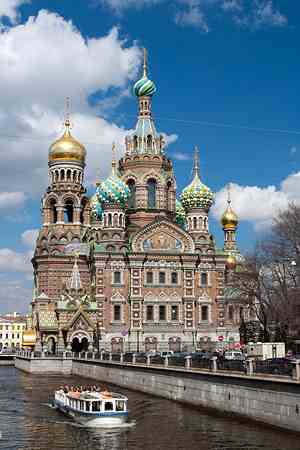
Church of Our Saviour on the Spilled Blood


Fima introduced me to all his amazing friends. Every one of them had an interesting story to tell. Astonshingly, they would rather tell me, a total stranger, their deepest held desires or worst fears for themselves than their friend because I would not betray them to the authorities, but their friend just might. Fima took me around the city each day, each night. We would simply take a different route home each time. Every second I spent with him became a grand adventure.We saw the palace that housed Pushkin’s Queen of Spades. We admired the mosaic icons in the Church of Our Saviour on the Spilled Blood. Or we would throw ourselves into the busy crush that was the department store Gum/Gym (Gosudarstvenny Universalny Magazin/State Universal Shop) and look for a suitably Russian fur hat for me.


Image

GUM


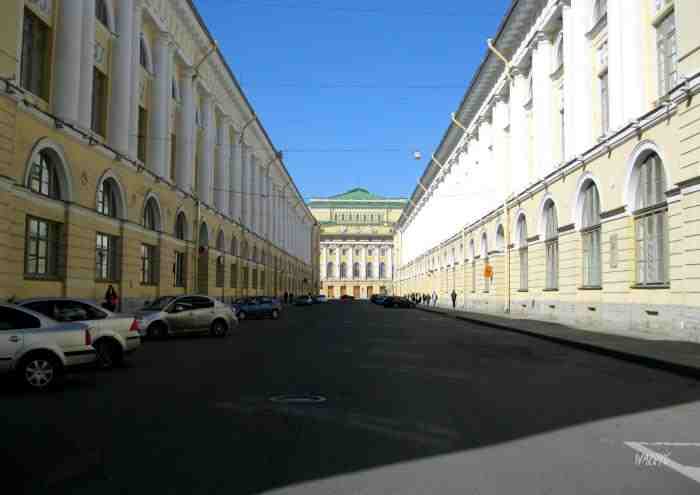
We marvelled at the architectural perfection of Architect Rossi Street. Located behind the Pushkin Theatre, this street is absolutely symmetrical. The two palaces either side of the street are identical, same colour, same facade, the theatre at the end is identical too. In addition, the length of the street is exactly twice its width, and the height of the palaces is the street’s width. Standing at the end looking up its length gives you a feeling of exquisite ‘rightness’. It is home to the Vaganova Ballet Academy, the Imperial Ballet School. It is feeder for the Kirov and the Bolshoi, and where Nijinsky, Nureyev and Barishnikov learned their craft.


Image 

Architect Rossi Street


I learned to love the city because I saw it through Fima’s eyes, experienced it in his company. It was exhilarating. St Isaac’s Cathedral, the Griboyedov Canal, the Peter Paul Fortress, Admiralty Square. Stopping for coffee and cake in one of the many cafes on Nevsky Prospect and of course visiting the Winter Palace, over and over, to pore over the enormous collection of museum exhibits, to appreciate the astonishingly beautiful architecture, inside and out.


Image

Griboyedov Canal


I wish every traveller a Fima, a Peter Pan, who will conjure a world full of surprise, of awe, of magnificence. A world that answers all your questions about music, art, architecture, literature, history, politics. A guide that truly makes a city a living, breathing thing that enchants, amazes, seduces.

THE PEACOCK CLOCK

12 Monday Nov 2012

Posted by Caro Field in Uncategorized

≈ 7 Comments

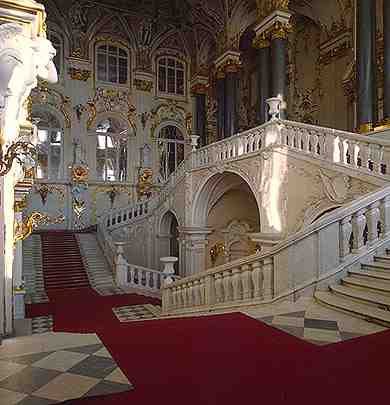
One of the most famous spaces in the Small Hermitage in the Winter Palace in St. Petersburg is the Pavilion Room (Catherine the Great’s dining room). You approach it via a huge flight of stairs, The Jordan Staircase. This was clearly designed to intimidate, and to overawe. It sweeps up extravagantly to the next floor in two directions, creating a natural stage at the top. 

Image

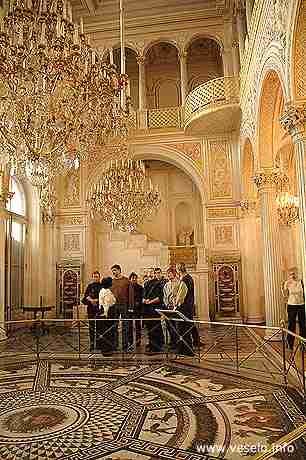
The Pavilion Room was designed by one of the most famous 19th century Russian architects, Andrei Stakenchneider. It has a colonnade of marble columns, supporting a gallery above that is graceful and elegant. On the floor is a copy of the floor mosaics that were unearthed at the roman baths at Ocriculum. There are four fountains, one at each corner of the room, picked out in a deep red marble and a staircase leads up to the gallery above.


Image


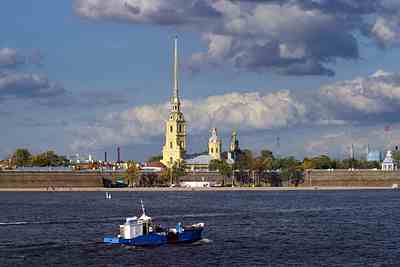
As you walk in, to the left, through huge, floor to ceiling, plain glass windows, is a wonderful view of the river Neva and the golden spire of the Peter Paul fortress on Hare Island beyond.

Image

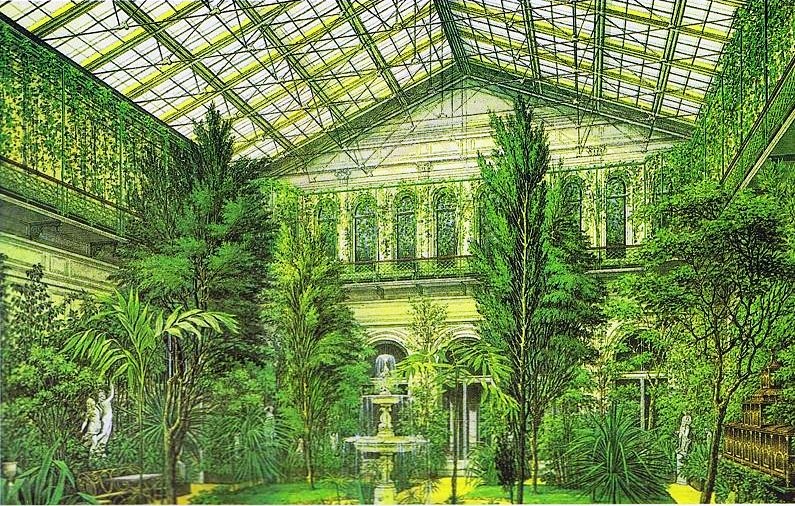
To the right is the winter garden a beautiful Italianate garden up on the first floor…In bygone years it was a gigantic glasshouse.

 Image

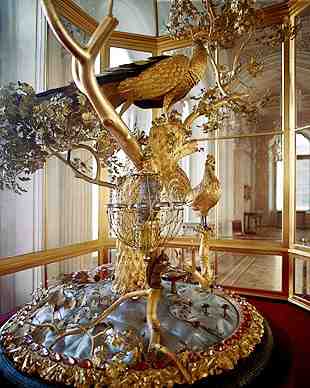
But the most famous feature of this room is the Peacock Clock, a ten foot high automaton. It was commissioned by Potiemkin and designed for Catherine the Great. Made in 1781 by James Cox, a London jeweller and goldsmith, it was brought to Russia in pieces and took 9 years to put back together again! But it was worth the wait. The clock features a gilded copper peacock on a branch, a rooster and an owl. On the hour, a moving cage rotates around the owl with a peal of tinkling bells. The owl’s head swivels and it opens and closes its eyes. The peacock lifts its beak, stretches its neck and opens it’s tail feathers with a flourish. It circles round to face the Neva, then circles back and lowers it’s plumage. The rooster crows. It is still in working order, although I am told that the museum only winds the clock for the White Nights Festival now, in order to preserve the mechanisms that drive the clock. Numerous features adorn the clock such as a squirrel eating a nut, and a dragonfly that acts as the second hand on the clock dial, which is on the head of a mushroom. 

Image 

This was never intended to show the time or to be a hugely accurate timepiece. This clock was made purely to impress. And it does. It is exquisite. Magical. Unique.

http://www.youtube.com/watch?v=_M3O_A6tmA8&feature=youtu.be

MARMIGHT

11 Sunday Nov 2012

Posted by Caro Field in Uncategorized

≈ 4 Comments

For my good friend @scribbler68 who is even more fanatical about the stuff than I am.


Image

Marmite. An iconic addition to our store cupboards and a fabulous way to start the day – marmite on toast, thickly spread. Even the pot it comes in is unique – named and styled after the squat, squashed French cooking pot that is featured on its label.


First we had the My Mate Marmite campaign. Then what a stroke of genius it was for Unilever to create the Love It/Hate It advertising for Marmite. Bold. Clever. Inspired. Particularly because their survey showed that more people hated than liked it. What Unilever counted on, however, was that those who loved it really loved it.


Because you either do love or hate it. And why wouldn’t you? It has a distinctive taste. However, I am of the opinion that everyone should have a bottle in their cupboard. It is natural; it is made from brewer’s yeast. It is vegetarian. It is rich in B vitamins, bioflavin, niacin and folic acid. It is low in fat and sugar. It has a sprinkling of herbs in it. Ergo it is good for you.


Historically, it has an impressive pedigree. It was a constituent of a soldier’s ration pack during the first world war. Tasty and nutritious, it was ideal because of its portability. It was used to treat cases of malnutrition in the malaria epidemic in Sri Lranka in the 30s. And, on a personal note, it was one of the “luxuries” I took with me when I went to live and study in Russia for 6 months. What is more, there were enough Marmite lovers amongst the British students for that first pot to disappear alarmingly fast. Whilst there, about half way through our stay, we were told by the British Consulate that a representative was coming out to meet  us. He would bring one item for each of us with him. What did I want? You’ve guessed it. Mine was the largest jar of Marmite he could find.


Marmite, I have to say, was vital. Necessary. I was in Russia in the 80s. Food was scarce. Meat impossible to lay your hands on. And we had to fend for ourselves. Eggs and onions were the only products you could easily buy. Oh, and vodka. Have you ever eaten eggs so often that just the smell of them cooking makes you want to vomit? Not to mention the taste. Well, I have. We tried frying numerous onions to disguise them. And then I got my second, large pot of Marmite and suddenly the world tasted good again. Marmite can mask even the stubbornest of flavours…and then if you wash it down with a wee bit of vodka – what’s not to like?


There are those of us who think it looks and tastes like tar. What do I think? Unquestionably salty. Indubitably yeasty. …and then there is that je ne sais quoi…is it that blend of herbs and spices? Who knows? Only Unilever presumably. All I know is that I would quite like to be buried with a pot in my hand and I shall pray for resurrection so I can keep on consuming it. Marmite lover? Me? Yes!…Oh, and I am waiting for Unilever to nick my tagline.

TO TWEET OR NOT TO TWEET ……that is the question

09 Friday Nov 2012

Posted by Caro Field in Uncategorized

≈ 8 Comments

Twitter had always been a closed book to me until a good friend told me ‘you must be mad! It is such a great way of people reading your work and getting a loyal following.., get your act together and start blogging and tweeting girl!’ 


So I did. It was something of a steep learning curve. I had not tweeted before because I did not really understand how it worked. Once you do, it is a writer’s playground. A great way to set out your store and market yourself…just so long as you don’t overdo it…


And I discovered that it so quickly and easily becomes quite addictive. That you encounter some of the wittiest, funniest people. That, equally you find the tenderest, most loving support network.


I post a comment. It is gently humorous. Within minutes, a brushfire occurs across the ether that encircles the entire world. I have one or perhaps numerous responses. Some make me smile, some make me thoughtful, some are actually laugh out loud funny. I find myself challenged by my peers to be witty, to make them smile in return, to lift their spirits as they have lifted mine. It is infectious. It is magical.


I post a comment about something that I find troubling. And this is what is even more astonishing; there is someone out there who responds, whether they know me or not. This person gives sound advice. Sage commentary. I find myself humbled by their generosity and their support.


And then there is the discipline of writing and posting something each day. It can be a lonely existence being a writer, so it is good to have some companionship and to get a response to your blog. 


So do you tweet or not? If you don’t then you should do. The camaraderie is infectious. The company is exhilarating. You make countless new friends. You learn something new each day. But you will learn just as much about yourself as you do about others. What’s not to like?

HOME

08 Thursday Nov 2012

Posted by Caro Field in Uncategorized

≈ 4 Comments

What is it about house hunting that daunts even the stoutest of spirits? Is it the relentless scouring of newspapers and websites to try to find a place that suits? Is it the hopeful trail from place to place, only to be disappointed? Is it the frequent shock on seeing the decors that people choose for their home? Is it the crushing realisation that a lot of work needs doing to make the place half–civilised?


But oh! When you step into a house that calls to you, resonates with you, it is as if you and the house breathe as one. You can overlook its weaknesses, both large and small. You see the skeleton, the body, the heart of the house. You feel you know its secrets, the space expands to accommodate you, everything just feels right.  And, even though it belongs to someone else, it instantly feels like its yours.


You quietly assess what alterations you would make; how you would change the use of  the rooms, knock down walls, move doors or windows, if necessary…You think of colours and accents and what you would retain and what tear out and replace. You know which fixtures are vital to keep and which the owners would be welcome to take with them. The house feels as if it is inviting you to take ownership of it. 


…and then, when your offer is accepted, a whirlwind of agents, bankers, surveyors, lawyers. But until that contract is signed, and the money exchanges hands, you keep everything crossed. You do not breathe. You close your eyes,  you pray…. And when it is done, dusted, signed, sealed, you pick up the keys and walk into a building that is new to you yet feels as if it has sheltered you for a lifetime. You feel warm and toasty, you feel safe, sound,  you feel like you are home.

VISUAL SCRAPS

07 Wednesday Nov 2012

Posted by Caro Field in Uncategorized

≈ Leave a comment

In the Spring, magic happens outside my bedroom window. A wren builds her nest in a blackthorn tree beyond and teaches her fledglings to fly from my window sill. She launches herself off then turns, and flapping her wings furiously, hovers in front of her babies chattering at them ten to the dozen as if to say ”Breathe in and jump! Take a leap of faith! Look, your mother is doing it!” and these tiny little birds, lined up along the window ledge, flutter their even tinier wings, screw up their courage and launch themselves into space…


I love lying in bed when it is raining outside. I am snuggled under the covers, warm and safe, and the world beyond my window sounds so unremittingly cold. The percussion of the raindrops drums a steady, soothing rhythm in my head and in my heart. It is as if a lover were marching her fingers down my spine to an exquisitely slow beat. And although it is divine torture and I confess that I love the mere thought of it, it is as if I can feel the long, hard slide of the rain on my flesh and it makes me shiver involuntarily…

RAMSCOMBE

06 Tuesday Nov 2012

Posted by Caro Field in Uncategorized

≈ Leave a comment

There is a small pocket of land in the midst of the Quantock Forests known as Ramscombe. It is magical. Sometimes, if you arrive early in the morning, before the dew is off the grass, you might find a herd of Quantock ponies grazing. They are shy and extremely protective of their young yet not wild enough not to be curious. They allow you only so close before skittering away, all stamping hooves and fierce nostrils. It is a peaceful place. The silence is broken only by the stamp of an unshod hoof or a birdcall.

At midday the whole atmosphere changes. The small road that encircles Ramscombe suddenly becomes busy. This is where the locals go to socialise and barbecue in the summer months. The council, with astonishing foresight, has built a number of barbecue pits. We locals roll up with meat, salad and posses of children and it becomes a free for all in the nicest of all possible ways.

It is a large pentagon of grass tumbling down a slope to form an inviting bowl at the bottom. It is surrounded by woods on every side, and at the bottom edge by a trickle of stream. The water meanders gently over a scree of pebble and earth to join a faster flowing stream at the far end of the valley.

The land climbs quite sharply to a lip at the top and the kids have endless games of tag or rolling down the hill. To the uninformed eye, they gather speed at an alarming rate before the natural contours level out and steepen again to bring them to a gentle stop. It is glorious. The right amount of open space for sun-worshippers, the right amount of shade for those who want to shelter from direct sun. Enough room for everyone.

Ramscombe has a congenial air about it. You meet families there you will never meet again, yet for that moment in time, you become the firmest of friends. Or you only meet those families in that one spot, year on year, but both adults and children pick up where they left off. Spend one day there and you can’t help feeling that there should be a Ramscombe in every neighbourhood.

FRIENDSHIP

03 Saturday Nov 2012

Posted by Caro Field in Uncategorized

≈ Leave a comment

I have been reflecting over what a true friend means to me… 

Friendship is defined as a state of mutual trust and support between two people. Indeed, friendship cannot exist without that trust…so when it goes from a relationship, the friendship falters and may die altogether. It is not that friendship is fragile, simply that trust is hard to earn and quick to lose and forms the foundation of any truly meaningful relationship. 


The Japanese use the term kenzoku, literally translated as family, to define a bond between two people which surpasses the commonplace, it is a bond that implies a really deep connection. So why do you have kenzoku with some of your friends and not with others?


Interests in common are vital to a good friendship because without them you will have little to interact over and even less to talk about. That does not mean to say you cannot be friends with someone who does not like what you do, just that it is improbable that you will have that deep connection. It is also a given that you would never ask a true friend to compromise their principles for you. You are there to help foster their highest aspirations, not feed their baser instincts and the trust between you is unquestioned. So what is it that draws such people to you, and with whom you feel that you are ‘home’? 


On paper this is simple.  You do not need to be what you think others expect of you (that is more likely to drive people away because you are not being true to yourself). You just need to be your own best friend. If you do this, you are likely to attract to you like minded people, who share your interests, approve your goals. Gandhi once said, ‘Be the change you want to see in the world,’. A kenzoku friend will love you for who you are and not for what you do. 


A real friend may not agree with you and will certainly challenge you, but will hold your hand if you need it and be the only one still there to help when others have long gone.  A kenzoku friend not only listens, but also hears us. Hears both what we do and do not say and acts accordingly. 


But above all, a great friend should make you feel good, and you should do the same for them. Yes, your heart may ache for them, if they are facing hardship, but mostly they should make you feel energetic, vital, accepted, loved. A kenzoku friend wants to see you thrive and prosper, is supportive, nurturing, and non-judgmental.They will be honest, not sugar coating their disapproval when you are found wanting, but they are patient with you if you seek to put things right.


Such a friendship is an intimate relationship. It may take some time to cultivate but it is priceless. Nurturing it is hard but oh, so essential. It requires commitment, truth, trust and respect. With all these qualities in place, a great friendship should last for years, lifetimes possibly, and through life-changing experiences for both of you. You may only come across a friendship such as this once or twice in a lifetime. It is a rare thing, a precious thing, a blessing, a grace. It is a relationship to cherish, to treasure!

THE QUICK FIX

01 Thursday Nov 2012

Posted by Caro Field in Uncategorized

≈ Leave a comment

This is a fast food, quick fix world. We live in an age that encourages us to think that there is an easy and swift solution to everything. We don’t like the fact that we are ageing, so we have a face lift. And once we’ve had one we probably have more, to complete the illusion that we are frozen in time. But you know what? We’re not really fooling anybody and eventually we’ll be blinking with parts of our body never intended for the purpose.

To find ourselves we have to commit to a journey with no short cuts. We need to understand that there is no easy solution. Life was always intended to be a learning curve. If we continually take the by-pass or the quickest route, we never learn anything about our human condition and the lessons we were put into this world to absorb remain a closed book, as we do ourselves.

There may be many of you who don’t want to learn these truths, they are too hard or too painful. The sad reality is that if we continually dodge the hard stuff, we miss out on forging the most amazing relationships and learning new skills from the most unexpected quarters.

So many of us go through life unintentionally hurting ourselves by absorbing and releasing negative energy. I live with constant pain. Every waking moment is filled with it. It is relentless. If I let any negative energy in to my body, be it hurt, humiliation, anger, despair, my pain increases exponentially. So I know, and this is with complete conviction, that every so-called ‘healthy’ person, who is carrying negative energy with them is literally poisoning themselves, not the person at whom their anger or vituperation is aimed.

Some self-help books seem to tell those of us who have long-term health conditions or terminal illnesses have given it to ourselves. This makes me angry because it is simply not true. We all, regardless of our health or illness, have issues that we have to deal with. Telling someone who is living with a crippling or life-threatening illness that it is self-inflicted is utterly counter-productive. However, what is true is that if we do not tackle life head on even if it has thrown us a curve ball, we will learn nothing. If we do not take life by the horns and confront it and refuse to let it get the better of us, we will forever live with what could be rather than what will be.

The simple truth is that if you seek to improve your health, you need to start from a point of positivity. This is hard. It is very hard. Particularly since many long-term health conditions are so unpredictable and this makes the process of returning to health a precarious entity, fraught with frustration and disappointments. But what I have learned is that dealing with any illness with all your intention, all your focus and all your positive energy will at least keep you feeling better about yourself and your chances than allowing negativity in, which depletes and diminishes you.

Many years ago, just after my daughter was born, I had a kind of epiphany, which opened a part of my brain that I believe that we all possess, the part of the brain I call primitive. This is not to say it is unformed, crude or uncomplicated, I mean the exact opposite. This is a part of our brain that belongs to our early ancestors, that connected them fully to the earth, the part of the brain of prehistoric peoples that kept them alive in a savage world. Since we have become ‘civilised’ we have become more and more divorced from our world, and our understanding of its intricate and complex processes and we have abandoned the skill of intuition, an inherent gift that is in all of us.

This is the part of the brain that a true psychic will use. I know because for those 3 days and many weeks after, I was one. I knew what the weather would be just by smelling the air; when it would rain, whether a breeze would come up. I would know when the phone rang who would be on the other end of it. I would know when thinking of a person and looking at my watch what they were doing at that exact moment in time. I could describe clothing my husband had bought without seeing it. I knew where this ability came from, it came from unconditional love and a fierce need to protect the child that had just been born to me and my husband.

During an extraordinary 3 days, I didn’t sleep at all but I did have a series of revelations, about my connectedness to the earth and how this could be achieved, about life, about what we have to observe when we approach any problem. The truth is that it is such an easy lesson to absorb. But here’s the kicker, it is not so easy to practise!

I understood that everything in this world is a direct reflection of something else. Pain’s opposite is comfort, the mirror of joy is despair, and illness’s reflection is wellness. If you approach the particular problem of health or lack of it as if it is a coin, heads is ill and tails is well, then as someone who is facing a life compromised by illness of some kind, if your focus is on the wellness side of the coin, you are using the extraordinary power of your mind to help your health improve, even if it is only infinitesimally. Improvement always equates to success.

So live in and for the moment, positively. Now is all we can really, truly be sure of; why waste time on  what has gone before or what is yet to come? We cannot change our past, and why would we? We are a product of it and hopefully we will have learned something from our successes, and, more likely, our mistakes. We cannot second guess our future either. Why would we want to? That is like guessing what someone has given you as a present. It diminishes the thought that has gone into buying the present for you and it is so much nicer to get a surprise. Living in the moment allows us to experience life as it happens, and to not miss a second, doing it positively means that the journey will be a great adventure.

← Older posts
Newer posts →

A Four Letter Word – Buy Here

My Facebook Page

My Facebook Page

Enter your email address to follow this blog and receive notifications of new posts by email.

Join 1,534 other subscribers

Gallery

This slideshow requires JavaScript.

Blog Stats

  • 97,644 hits

Tags

artwork barcelona beach bear bend boat books brazil bridge butterfly canal caravan cars cats celebrity chef child chimes china Crowcombe desert dogs drinks eca embellishment equestrian fame flowers France friendship green guitar handbags happiness home Italy Japan joy lavender London love map music nature O P poetry puddings rain rainbow river rivers rosd salmon sand sea ships shoes shopping sky sleigh snow somerset spain stardom statue sunrise sunset The Road to Crowcombe trees walk walking weather winter world

Blog at WordPress.com.

  • Subscribe Subscribed
    • Caro Field Author
    • Join 409 other subscribers
    • Already have a WordPress.com account? Log in now.
    • Caro Field Author
    • Subscribe Subscribed
    • Sign up
    • Log in
    • Report this content
    • View site in Reader
    • Manage subscriptions
    • Collapse this bar
 

Loading Comments...