• About Caro Ness

Caro Field Author

~ Thoughts and musings and poetry

Caro Field Author

Category Archives: non-fiction

Coffee…

20 Monday May 2013

Posted by Caro Field in non-fiction

≈ 22 Comments

Ann Mullen asked me to write more about where coffee comes from and how the flavours differ…so here we go! I have slightly rewritten this post for my darling as a guest blog for her Meat Free Monday  on Lover of Creating flavours today.

images-7Around about 600 AD, legend has it that a young Ethiopian goatherd by the name of Kaldi saw his goats feeding off particular shrubs which, upon eating their reddish-brown berries, seemed to energize them. He too tried the ‘berries’, as did some monks who observed him, and so the buzz that coffee gives us was discovered. Not surprising, given the fact that the Yirgacheffe region is known for its intensely dark, fruity coffee and the country is renowned for its espresso coffees in particular.

By 1000 AD, the Arabians were roasting and brewing the bean and by the 13th century, the Muslim nations were regular coffee drinkers. In those days, Muslims were trading in Africa, the Mediterranean and India, so its popularity gradually spread around the world. However, the Arabian traders boiled their beans before selling them, ensuring this would make them infertile and so the cultivation of the bean would remain confined to Arabia and Africa.

This monopoly was finally broken when an Indian pilgrim to Mecca, Baba Budan, smuggled some beans out of the country and by 1616 the Dutch had established the drink throughout Europe and by 1696, had set up the first coffee estate in Java. The Dutch, to this day, are leaders in coffee production. In 1792, Lt. Col. Francisco de Melo Paleta smuggled the bean to Brazil and although it started out as a drink for the elite, it very quickly became a favourite with the entire populace, and so the long and noble tradition of coffee cultivation there began.

So let’s start with Brazil, which is the largest coffee bean producer in the world. Ironically, its tiniest island, Réunion, formerly known as Bourbon, produces a cultivar of particularly aromatic beans, that are dark, with a delicate balance of acids. Other great coffee from this part of the world is the bean from Colombia, which has a much lighter, sweeter flavour, the one from Panama, that has a much fruitier overtone and Nicaraguan coffee which is powerful and full bodied.

Move further north to Cuba, where the coffee is as punchy as the cigars; it is seriously strong with a kick like a mule. Jamaica, my homeland, produces one of my favourites, the mellow nectar that is Blue Mountain coffee and Hawaii cultivates a bean that is very full-flavoured yet simultaneously smooth.

Travel round the world to Indonesia and Malaysia for the famous Javan – so famous that a java is American slang for a coffee. The Sumatran is not as harsh as the Javan, having a thicker, sweeter, gentler flavour. Move on to India,  where it seems that Indian coffee appeals to the European palate because its reputation for producing a fruiter, sweeter, less acidic coffee was ratified at the Grand Cus de Café contest in Paris in 2004, where an Indian coffee won 3 gold medals. Then travel west to Yemen which produces some of the most famous mocha coffee in the world. Mocha is actually a port on the Red Sea in Yemen, which is famous for its coffee beans. The word mocha is now synonymous with the coffee beans which have an intense chocolate overtone.

Some won’t forgive me for not including El Salvador, which produces a coffee bean that is chocolately, nutty and has a hint of caramel, or Papua New Guinea, also nutty and chocolatey, or Costa Rica, whose beans produce a fruity coffee with a creamy finish. You will all have your personal favourites, this post is just a small illustration of the fact that coffee, just like wine,  differs radically according to its provenance. I just urge you to broaden your horizons, educate your palates and see how wonderfully diverse the world of coffee truly is….


images-8

The Liebster Award

09 Tuesday Apr 2013

Posted by Caro Field in non-fiction

≈ 16 Comments

imgres

I have been nominated for another award. This time Jeremy Booth of the wonderful http://americanviajes.blogspot.com.es/ has nominated me for the Leibster Award which is given to bloggers who celebrate and help you find new blogs.

The rules of the Liebster Award:
  • When you receive the award, you post 11 random facts about yourself and answer 11 questions from the person who nominated you.
  • Pass the award onto 11 other blogs (make sure you tell them you nominated them!) and ask them 11 questions.
  • You are not allowed to nominate the blog who nominated you!

Here are some facts about me:

1. Not long after I was born (in Jamaica), I contacted impetigo and had to be painted from head to toe in gentian violet. Consequently, I was known as “the blue baby”.

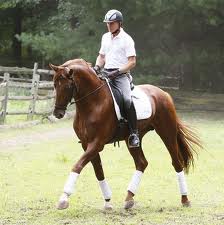
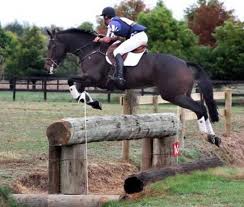
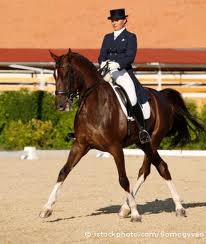
2. In my youth I used to compete in horse events, one to three day events, dressage and show jumping. I always intended to try polo but never got round to much more than treading in the turf after a chukka and drinking a glass or two of something alcoholic.

3. I am so allergic to mushrooms that when I was given a treatment called plasmaphoresis, in which all the plasma in your body is transfused, I had to be given intravenous anti-histamines because the donor was a mushroom eating vegetarian!

4.My great uncle was headmaster of one of the most famous schools in South Africa, Diocesan College in Cape Town. His wife, Mary Matham Kidd, was one of the most famous botanical artists of her generation and her book, Cape Peninsula, Wild Flower Guide, is considered a seminal work.

5. I played cricket for my university, Durham, tennis for my college, the College of St Hild and St Bede and swam for my county,Hertfordshire.

6. My first cat was called Snowy, the first dog I can really remember was called Digger.

7. One of my favourite streets in the world is Architect Rossi Street in St Petersburg, Russia.

8.I sang in a Christmas Concert at the Festival Hall in London with my school choir.

9. My partner and I are planning to try to start making cheese.

10. I would love to travel around South America.

11. I have a penchant for puddings and my favourite is Crème Brulée, my favourite to make is Iced Hazelnut Soufflé.

The questions that were asked of me were:

1. What is one hobby you wish you had more time for? Playing mah jong. I am addicted!

2. What is one bad habit that you cannot kick? My passion for puddings!
3. If Earth was being abandoned and the human race was leaving for another planet, what natural feature would you miss most? The Earth itself – it is such a beautiful planet and I would miss breathing fresh air.
4. Who is one person who often makes you laugh until you cry? My partner.
5. Tell me your favorite fruit, favorite vegetable, and one other favorite food. Guava, French beans, chestnuts.
6. What is one place you have been to that you think more people should know about? The Okavango Delta in Botswana.
7. Where do you consider to be your watering hole? I am about to move and i believe it willl be Westow House in Crystal Palace or my own home!
8. What is one international dish you wish you knew how to make? I would love to be really good at making tempura.

9. Who is your longest lasting friend and when did you meet? Dido Arthur, we were born 2 weeks apart and have known each other ever since.
10. If you had a hot date tonight, what would you wear? My beautiful silk jacket.
11. How has your relationship with your blog changed throughout the time you have written it? It hasn’t much except I have been writing more poetry recently.

I nominate:

Veronica Sheather for http://foodthatsings.com/

Cher Fauvel for http://rawfoodenergybenefits.com/

Suzy Que for http://suzysomedaysomewhere.blogspot.co.uk

Angie Schaffer von Scheffelheim for http://www.thelittlejazzbaby.com

Roy Ackerman at http://www.adjuvancy.com/wordpress/

Carol Tomany at http://divineknits-infiknit.blogspot.ca/

Alessa Bertoluzzi at http://www.carolinaheartstrings.com/

Suerae Cobbs Stein at http://redbarnartworks.com/blog/

Alana Mautone for http://ramblinwitham.blogspot.co.uk/

Cairn Rodrigues at http://www.lightstealers.blogspot.com/

Charlie and Caroline at http://charlieandcaroline-pedlars.blogspot.co.uk/

If you agree to participate, here are my questions for you:

1. Have you an ambition you still want to complete?

2. Which 5 famous people (dead or alive) would you choose to have dinner with in a virtual world?

3. What is your favourite book?

4. Do you have a phobia about anything, if so what?

5. If you could choose to travel anywhere in the world, where would it be?

6. If I could wave my wand and grant you a wish, what would it be?

7. What is your favourite smell and why?

8. If you could be the hero of a book or film, which would it be and who would you be?

9. What is your favourite meal to cook and to eat?

10. What is your favourite colour?

11.Is there a quote you think particularly brilliant and you wish you could have come up with, what is it and who said it?

Horses

26 Saturday Jan 2013

Posted by Caro Field in non-fiction, poetry

≈ 4 Comments

imgresTug of muscle,
Stretch of sinew,
Smooth, silky,
Rugged, strong.
Soft, subtle,
Quiet, electric.
Tender, fierce,
Intelligent.
Synchronicity.
Magic.
When we get it right,
Poetry in motion,
Moving meditation,
Symmetry.
We KNOW one another.
TRUST one another.
UNDERSTAND one another.
Tiny adjustments made by us both
To attempt perfection.
When it works,
A knife through butter,
A sailing boat leaning away from a following wind,
imgres-2A balanced boat, an eight, slicing through water.
Emotive words set to a beautiful tune,
Resonant, familiar.
We are two, yet we are one.
Sensuous.
Nourishing.
Intoxicating.
…………… BLISS.imgres-3

Snowflake

25 Friday Jan 2013

Posted by Caro Field in non-fiction, Prose

≈ 21 Comments

Since the rather wonderfully named Waterlooville, here in South England is currently under inches of snow, I thought I would write a blog about it!

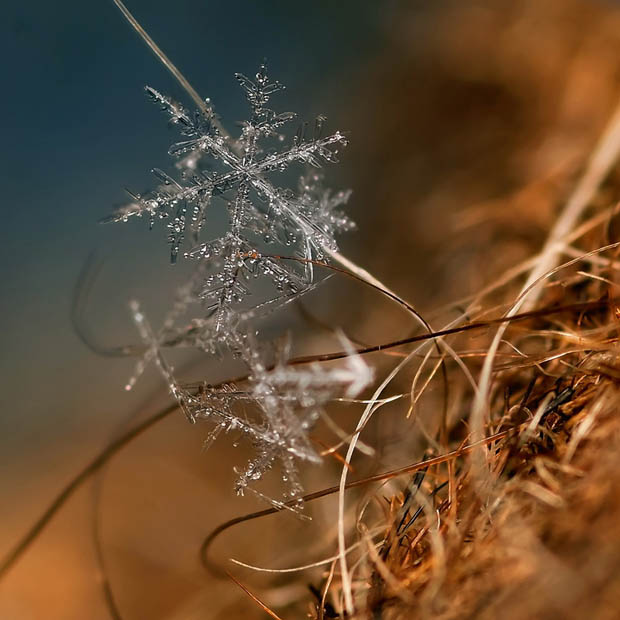
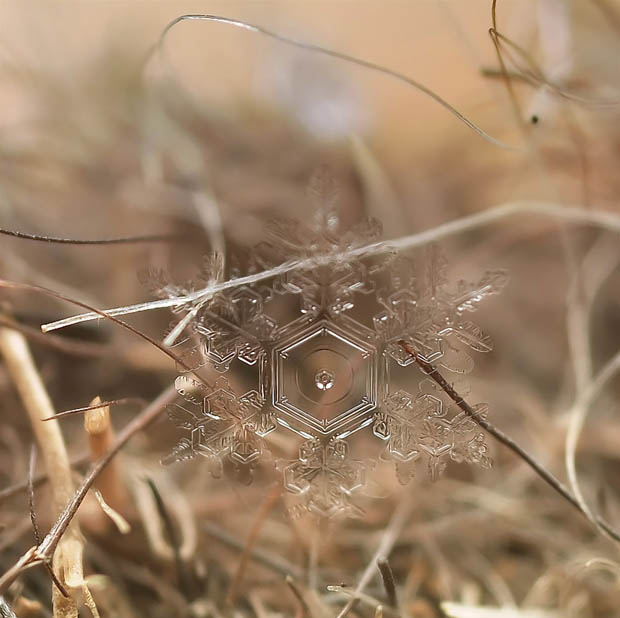
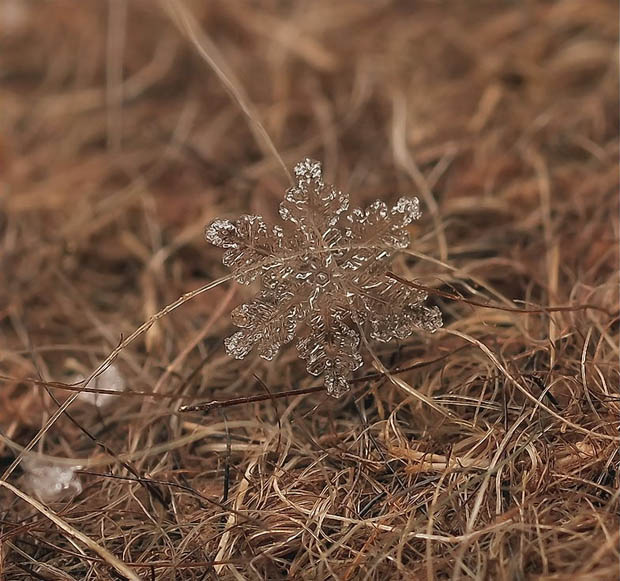
A snowflake can be either a single ice crystal, two of them fused together, or a whole mass of them getting together to have a party, to make a kind of snowflake puff ball. Snowflakes are not frozen raindrops, that would be sleet. Instead they are crystals which form when water vapour condenses straight into ice in the clouds. The unique shape and pattern of each snow flake gradually emerges as the crystals grow.

macrosnow-2

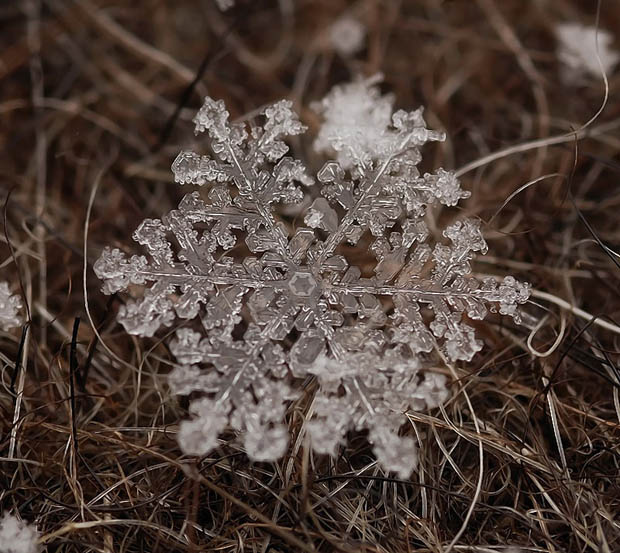
A snow crystal, that may be round, will attract material to it, because it is rough, but then there may also be a number of facets that are smoother and so accumulate material much more slowly. After all the rough surfaces have grown out, only the slower-growing facet surfaces remain, to create the snowflake. A snowflake is, most commonly, a hexagonal prism in shape. This, in turn can either be plate-like (or flat), or columnar, depending on which facet surfaces grow the quickest.

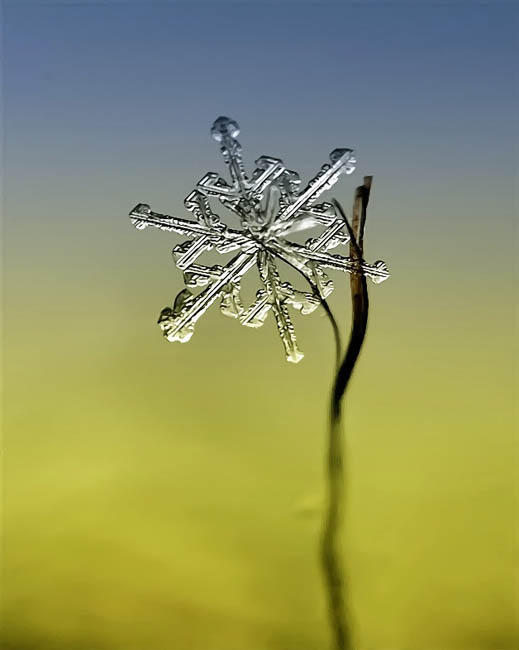
ImageWhen snow flakes are just baby flakes, they tend to just be these hexagonal prisms, but as they mature and grow, branches grow out from the corners to create more intricate and complex shapes. This perfection, is, like so many things in this world, created from imperfection. Snowflake branching occurs because in order for water vapour to attach to the ice crystal, it has to diffuse through the air. If it finds a spot on the crystal with a tiny protuberance, it does not have to travel so far through the air to condense, so it tends to concentrate itself around and grow quicker at that particular spot…creating a branch. Then that branch in turn may have minor imperfections, so the process repeats itself. The result is an exquisite structure…unique to itself, because no two ice crystals will have lumps and bumps in the same spot. Cool physics, huh?

Image

Now for more interesting science! Thin plates and starlike flakes tend to develop at temperatures of -2º C (28 F) and -15º C (5º F),columns and needles at around -5º C (23º F) and a combination of plates and columns at about -30º C (22º F). Also snow crystals tend to form simpler shapes when the humidity is low, and more elaborate ones as the humidity rises.

Image

So the life of a snowflake entails evaporation of the water vapour from seas, lakes, rivers, plants, even you, when you exhale! If you take that air and cool it down, it will eventually condense, as dew if it is near the ground, as snow, if it is way up high.Snow-forming clouds are just conglomerations of liquid water droplets, until the temperature drops to about -10º C (14º F) and then the droplets gradually start to freeze, as described above.

So the next time it snows, consider the complicated evolution of that single snowflake that lands on your hand!


macrosnow-3

Something Few People Know About Me

23 Wednesday Jan 2013

Posted by Caro Field in non-fiction, poetry

≈ 19 Comments

ImageThe matter concerns my birthday,

Which I share with a writer who’s brill!

She’s an author, an artist,

She’s simply the smartest,

I love her and always will.

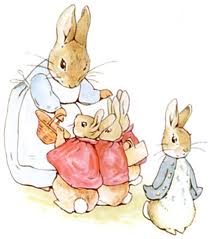
She wrote of the wonderful Pigling Bland,

Samuel Whiskers and all his tricks,

She wrote them as pieces,

For nephews and nieces,

So big up for the marvellous Beatrix*!

*I was born rather more recently,

Ms Potter? 1866.

Image

The Ballad of Dan Donoghue (or how to survive the Zambezi)

22 Tuesday Jan 2013

Posted by Caro Field in non-fiction, poetry

≈ 13 Comments

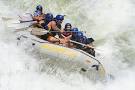
ImageTook a raft trip down the Zambezi,

There were 8 of us in the swim,

Peter, Rob, Malcolm, J and myself,

2 sisters from Medellin.

And our guide, Dan,

‘The man who can’,

Who was intent on keeping us in.

Dan was a page 2 Adonis,

With a truly awesome physique,

He’d spectacular pecs

Wore minuscule kecks,*

And an air of intrigue and mystique.

Yes, Dan, Dan,

A peach of a man,

Displayed his outstanding technique.

We all had to paddle as hard as we could,

In order to simply survive,

We’d a rule book to follow,

“If you fall out, don’t swallow!”

We were warned in the event we capsized.

So said Dan, ‘the man’,

His face dead pan,

“If you don’t you will simply nose-dive!”

“Keep both hands on the top of your paddle,

And I beg you to never let go”,

If we did it would be

A catastrophe,

As future events would show.

So Dan, Dan

Warned each ‘man’

“The result, you just don’t want to know!”

He also instructed us, what to do,

If, God forbid, we came out of the boat,

“Relax, and don’t worry,

Don’t struggle or flurry,

I’ll throw you a line, so just float.”

And Dan, Dan,

Said, “If you can,

You all need to learn this by rote.”

We got to the very first rapid,

The water just dropped away,

And a wave of real dread

Loomed six feet overhead,

So we forgot what he had to say.

And Dan, Dan,

Could not help his clan,

And I ended up in the spray.

I got sucked right under that rapid

With a horrible blood-curdling hiss,

Down there in the gloom,

I had a feeling of doom,

A million miles from bliss.

But Dan, Dan,

Gave the river a scan,

To see when I tried to surface.

That rumbling white water was fright’ning,

And there was a terrible din,

Didn’t know up from down,

It was dark, it was BROWN

I counted my every sin.

But Dan took great care,

And when I came up for air,

Threw his rope out, to pull me in.

We were fine till the fourth big rapid,

Then every one of us tumbled out,

We lay in that pool.

All enjoying the cool,

‘Cos the full midday sun was out.

Till Dan, the man,

Said, “Get back in if you can,

You know there are crocs about!’

In the next big shoot of water

Something hit my face with a thud,

With that mighty thwack,

I saw stars, it went black,

And it felt like my nose was in flood.

And Malc** screamed to Dan,

“Stop the boat if you can,

My wife is all covered in blood!”

It seems that one of the Medellin twins

Had lost control of her oar,

In the hubble and bubble,

She’d got into trouble,

Couldn’t hold on to it any more.

And even though Dan

Had outlined that plan,

She hit me fair and square on the jaw.

Dan swiftly gave an appraisal,

Of the lump on the side of my face,

It was frankly obscene,

I was red, blue and green,

With bruises all over the place.

So Dan, Dan,

With great élan,

Steered us out of that race.

He ‘surfed’ that boat through the waters

Through the rapid’s throaty roar,

While we all lay prone,

He paddled alone,

He proved what his knowledge was for.

And Dan, Dan,

Proved ‘he’s the man’,

And guided us safely to shore.

* slang term for underpants/pants, in this case, the tiniest swimming costume in Christendom

**Malc/Malcolm – my ex-husband

Hard Times

15 Tuesday Jan 2013

Posted by Caro Field in non-fiction, Prose

≈ 21 Comments

images-3

Recently someone I love saw 2 people that they cared about die, an uncle and a very best friend. I wrote a piece about it at that time to try to help bring consolation. I have revisited the subject, because we were discussing it again the other day and I felt there was more to be said.

Why is it that in the West we seem to be so bad at dealing with death when it comes to our friends, and coping with it when it visits one of our own? Why does it defeat us so completely? Sometimes it comes with foreknowledge, and we attempt to prepare for it but we invariably fall short. We do not want our loved one to suffer but to contemplate a world without them is impossible. And then we are left feeling guilty because our need for them may be causing them further distress, so our despair becomes magnified.

On other occasions, death bludgeons its way into our world without warning and shatters our peace, suddenly, shockingly, and we are left feeling bewildered, angry, defenceless. Why? Why now? Why was there no opportunity to say goodbye? Why us? And we can be sure that our friends, seeing and feeling our pain will be thinking, “thank heavens it’s not someone I love”. This isn’t an unkind or unfeeling response, it is really only natural. But sadly, it makes us feel worse and simultaneously makes our friends feel worse too for thinking it and there’s the uncomfortable stand-off.

Why too, do we find it so hard to name death? Why do people talk about ‘losing’ someone? They’re not mislaid! They’re are never coming back. They are dead. Nor have they ‘passed over’. They have not just suddenly become Jewish overnight, nor have they taken to flight. What’s with the euphemisms? As Monty Python would say, they are dead, defunct, they are no more. They have shuffled off this mortal coil. They are pushing up the daisies.

Death is always unwelcome. Yet it comes to every one of us. So why are we not prepared for its ravages? We know it is there, lurking, waiting, for each of us, so why are we not better equipped to deal with its consequences? If our loved one has an illness that we know will eventually prove fatal, why does the knowledge that they are no longer in pain not bring us more solace? It helps for sure, as does the knowledge that someone who died suddenly, did so almost certainly without any presentiment of mortality, yet we still struggle with facing life without their physical presence.

Grief is a strange bedfellow. It takes us all in different ways. I know I struggled for years to come to terms with the death of my mother, my friend with a father’s death. I simply couldn’t speak of my mother without choking up. Common to all of us, I believe, is that need to see ourselves as immortal, including those we love. When we are not, it is a devastating blow. One that every one of us struggles to come to terms with.

There are those of us, like myself, who have an illness that may well kill us, sooner or later, so we have tried to prepare ourselves to some degree. The notion of doing so is, of course, ridiculous. Although we may claim that death isn’t fearful, it simply isn’t true. We have not yet had to confront it. We have not yet looked it firmly in the eye and decided how we intend to greet its entrance. If death is imminent the struggle to deal with it is harder still. Many of my friends who have died have chosen to lock themselves away until they are able to mourn for themselves before they can allow those they love in, because they are painfully aware that those people they love are already struggling to prepare for their loss.

One of my friends, Mark, knew he was dying, but he had already made peace with himself. He then lived more fully in the moment than anyone else I have ever known. He knew he was going to die so he did not want to waste a single minute. And he didn’t. He lived, joyfully, until the day he died. My own mother, with characteristic bravery, chose to die. She was very single-minded so if she decided to do something, it always got done. Her illness, a very rare form of leukaemia, had left her very dependant on others, which, for a fiercely independent woman, was simply intolerable. So she sat down with our father, and wrote a letter to each of their friends. She told them she was dying. She told them she did not want them to read about her death in a newspaper. She told them that she loved them.

She made it very clear that she did not want to see any of her grandchildren, whom she adored, because she wanted them to remember her as she had always been to them. However, she wanted to say goodbye to each of her children so we all descended on her home to spend time with her. To laugh with her. To reminisce. To love her as she did us. Our brother was the last to say farewell and she died on the night he’d visited her earlier in the day. She died where she wanted to, in her own bed, surrounded by those she loved.

I have learned from my own loss that for some people, they may at first need to be quiet with their grief. Nevertheless, there will come a time when it is important to talk about the person who has died. Talking about the deceased does not diminish their loss but for those mourning it reminds them of all that made them fully them. What we need to do to support them in their grief is to ask them to tell us about the deceased and then be fully prepared to invest the time (no matter how long) to laugh and to cry as we hear them bear witness. In doing so we honour both the dead and the people they have left behind.

When I die I hope I have the courage to do what my mother and Mark did. I intend to live life to the full, then to make peace with myself, my world and my place in it, until the last breath leaves my body. And I also hope that by doing that, I will prepare those I love and who I know love me just a little for my loss. That if they close their eyes and ask me a question, if they ask me about something that is bothering them, they will instantly know what my answer would be. That I may not be by their side physically, or in their arms, but I will always be with them in spirit.

Jupiter

14 Monday Jan 2013

Posted by Caro Field in non-fiction, Prose

≈ 17 Comments

Our skies have recently become somewhat sexier with the arrival of Brian Cox on our TV screens in the UK. Formerly the keyboard player in a rock band, he is now a particle physicist and Royal Society University Research Fellow and Professor at the University of Manchester.

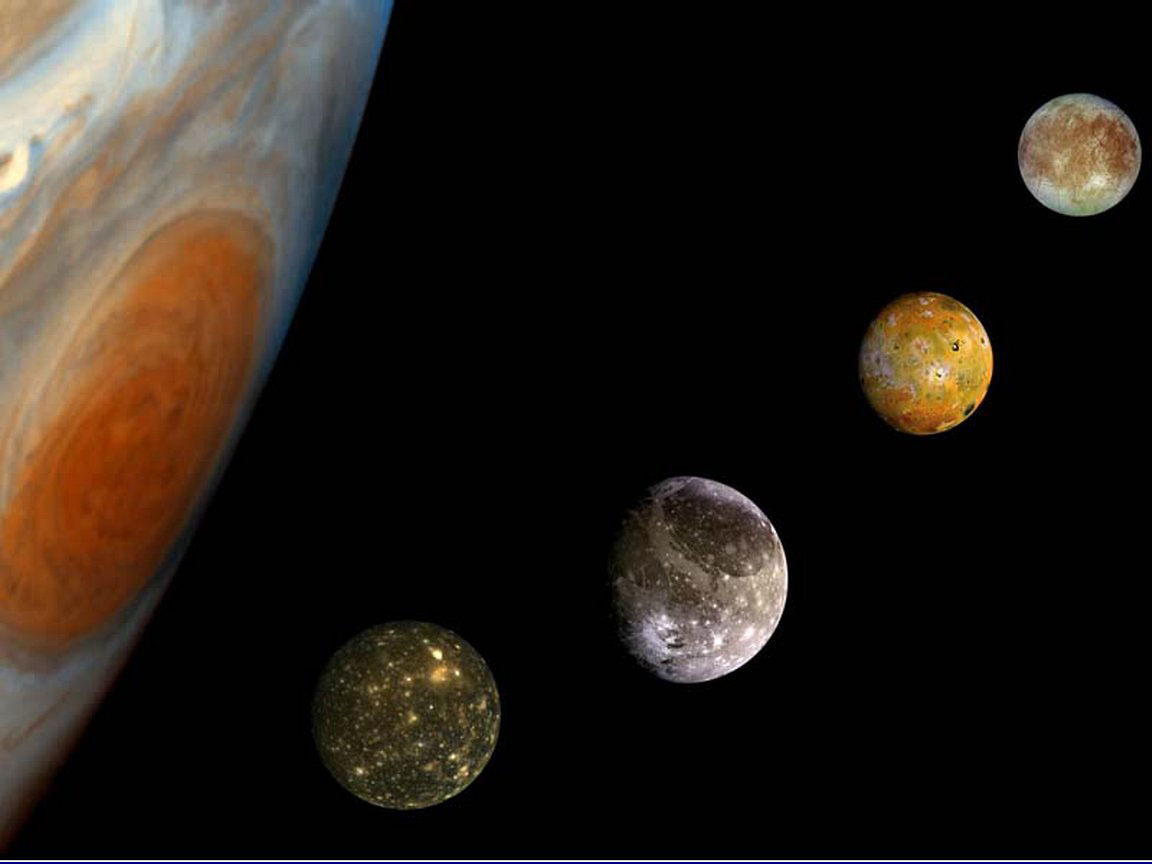
Jupiter. The largest planet in our solar system and named after the Roman king of the Gods by ancient astronomers. It is the fifth closest planet to the sun and is made up of 84% hydrogen, 15% helium and small amounts of ammonia, acetylene, ethane, methane, phosphine and water vapour.

A few facts about Jupiter. It is such a giant of a planet, that 1,300 Earths could exist within its volume. It rotates so incredibly quickly that days only last 10 hours and yet it takes 12 of our Earth years to orbit the sun. The planet has the largest moon in the Solar system, bigger than Mercury. It has over 60 known satellites, or moons, and they have wonderful names: Gannymede, Europa, Callisto and Io are four of them. The four major moons were discovered by Galileo Galilei in 1610 and were named for the lovers of Zeus.

Jupiter has a red spot, which is essentially a persistent anti-cyclonic giant storm that has been raging possibly since 1665, certainly since it was first spotted via telescope about 300 years ago. This Great Red Spot has roughly the circumference of the earth, which gives a stark realisation of the sheer size of this planet. Even before Voyager proved it was a storm, it was known that it bore no relation to the mass below it because it rotated at a different speed to the mass beneath it, sometimes faster, sometimes slower. During its recorded history, relative to any fixed marker on the planet below, the red spot has travelled round Jupiter several times.

The orange brown colour of Jupiter is due to the upwelling of compounds that change colour when they come into contact with ultraviolet light. No one knows their exact composition, but they are believed to be sulphur, phosphorous and maybe hydrocarbons. Theory posits that if Jupiter’s mass increased considerably, then it would shrink in size because the interior would be so severely compressed by the increased gravitational force generated. Fascinating, huh?

My last interesting snippets of information are that the planet’s mass is 70% of the total mass of all the other planets in the solar system and that if you weigh 100 pounds on Earth, you will weigh 264 on Jupiter. Lucky we live on this planet, yes?!

Exit the Dragon

13 Sunday Jan 2013

Posted by Caro Field in non-fiction, Prose

≈ 11 Comments

2012 was The Chinese Year of the Dragon – so it got me thinking as to why it is a creature of great good fortune in Chinese culture yet a monster to be feared and vanquished in the West.

images

In Chinese culture, the dragon represents power, authority, and is a harbinger of good luck. It demands respect. In the west, it is usually thought of as malicious and monstrous and commands fear and loathing. I know which dragon I would rather pursue!

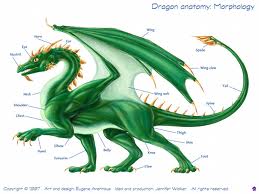
The western dragon of myth and legend overlaps in many different cultures/countries. It is usually depicted as scaly, with a tough, armoured hide. It often has wings, though it rarely flies, and lives in rivers, caves or an underground lair. The first mention of a dragon is in The Iliad but the Greek word used, drákōn, can also mean snake. Interestingly, the Slavic words for dragon, zmey, zmiy or zmaj, are all masculine words for a snake, which is normally feminine! These dragons, with the exception of the Red Dragon of Wales, are malevolent, and in need of slaying. Some of them are even depicted with 3 heads, and these heads grow back every time one is cut off!

images-1

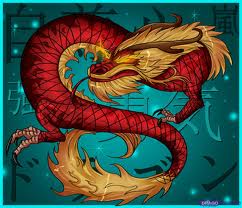
In stark contrast, the Chinese dragon is a beast to be honoured and revered. People born in a Dragon year are, according to the Chinese, uninhibited, non-conformist, free spirits who don’t play by the rules. They are masters of the grand gesture. They like to do everything on an epic scale. Creative, flamboyant, confident, fearless, they invariably make it to the top. They are irrepressible, energetic and hugely gifted, and they simply do not know when to stop. Generous to a fault, they are popular, but their impulsive natures can sometimes get them into trouble!

What is interesting to me is that the Year of the Snake follows the Year of the Dragon…so it is interesting that in Western parlance, the word used for it was used for both. Interesting too, that the dragon is often depicted as being quite serpentine in appearance…The Snake’s characteristics could not be less like the dragon, however. It is private, introspective, and self-composed. Where the dragon is bling, the snake is refinement. They both share the same desire to succeed, they just go about it in different ways.

The year 2012 was something of an upheaval for me, I don’t know about you, but I am looking forward to 2013 mightily, as a year of new beginnings, of good fortune, of joy.

View From A Roof

11 Friday Jan 2013

Posted by Caro Field in non-fiction, poetry

≈ 11 Comments

The remarkable Anita-Clare Field gave up A senior role in the publishing industry to be Director of Fundraising for London Air Ambulance. This poem gives us an extraordinary window into her time there. I am hugely grateful to her for guesting on my blog and I am privileged and honoured to be able to reveal to the world what a gifted writer she is. 

As time rolled on after my fathers very sudden death in January 2001 I became more and more disillusioned by everything, especially by the publishing company I’d been working for, for a few years. My grief magnified everything and for a while I thought I was drowning, I could barely function and after a year of fog I made a big decision. I decided that I’d hang up my publishing boots and go and use my commercial and business skills to benefit others.

I suddenly found myself standing on the roof of  The Royal London Hospital as Director of Fundraising at London’s Air Ambulance. It was the most humbling 14 months of my life, I saw life in the extreme. I met families, held their hands, cried with them, laughed with them and I learned so much. I learned about medical terminology like ‘claret’ and that it was the right thing to make breakfast if my colleagues were out on an early morning shout. I came to terms with so much during my time there.

One of the greatest things I learned was life is so very precious and that showing compassion and care to others is something I’ll never be able not to do and that the generosity of others when they are on their knees is simply amazing. I learned to deal with my own grief.

One day during my tenure my line manager at the time arrived for a meeting with potential donors in my office on the helipad and  she looked at the “two suits” and said “I keep telling her how lucky she is, how she’s got the best view in London” She was talking about my view of the city of London and south, all the way home to Crystal Palace. She was trying to appease after my finding yet another anomaly. In some respects she was right about the view, however, as I drove home that night, I thought about it more and when I arrived home that evening I wrote this about my view.

View from a roof

2‘ I keep telling her she has the best view in London’

Just words, justification for the disorder,

What I see is different,

What I see is beauty,

Shining, glistening in the sunlight,

It’s reflection in the puddles left from the overnight rain.

It’s metal blades casting a shadow in the midday sun,

A haze in the distance obscuring the landmarks.

What I see isn’t materialistic or shallow,

not a status symbol.

What I see is life, cutting edge, vivid, stark, sometimes horrific images,

What I see is a different view everyday.

How am I supposed to be feeling?

lucky? grateful?

What I feel is pride and privilege,

What I feel is different, an opposing view, a different vision.

I do have the best view in London,

I do have the best view of this strange yet magical world,

but not because SHE says I should.

← Older posts
Newer posts →

A Four Letter Word – Buy Here

My Facebook Page

My Facebook Page

Enter your email address to follow this blog and receive notifications of new posts by email.

Join 1,534 other subscribers

Gallery

This slideshow requires JavaScript.

Blog Stats

  • 97,123 hits

Tags

artwork barcelona beach bear bend boat books brazil bridge butterfly canal caravan cars cats celebrity chef child chimes china Crowcombe desert dogs drinks eca embellishment equestrian fame flowers France friendship green guitar handbags happiness home Italy Japan joy lavender London love map music nature O P poetry puddings rain rainbow river rivers rosd salmon sand sea ships shoes shopping sky sleigh snow somerset spain stardom statue sunrise sunset The Road to Crowcombe trees walk walking weather winter world

Blog at WordPress.com.

  • Subscribe Subscribed
    • Caro Field Author
    • Join 409 other subscribers
    • Already have a WordPress.com account? Log in now.
    • Caro Field Author
    • Subscribe Subscribed
    • Sign up
    • Log in
    • Report this content
    • View site in Reader
    • Manage subscriptions
    • Collapse this bar
 

Loading Comments...