
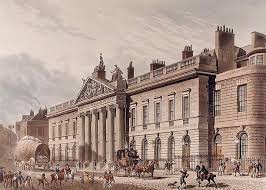
 The Btritish East India Company was easily the most powerful commercial organisation that the world has ever known. At the height of its influence, it not only had a monopoly on British trade with India and the Far East, but it was also governed most of the Indian sub-continent. These two factors mean that the East India Company was crucial to the history of the tea trade.
Before 1600, Portugal controlled most trade between Europe, India and the Far East. However, in 1600 Queen Elizabeth I gave a royal charter to a new trading company, the East India Company, by which it was given a monopoly over all British trade with the Indies. The Company soon began competing with the Portuguese, as did similar companies, set up in the Netherlands, Denmark and France. The East India Company’s first major base was in western India, where it found a rich source of exotic textiles amongst other things, which could be exported back to Britain or taken further east to exchange for spices.
The Company successfully negotiated its way through the stormy wters that were British politics in the seventeenth century. Oliver Cromwell provided the merchants with a new charter after Charles I was deposed and the Commonwealth established in 1649. Then when Charles II was restored to the throne in 1660, the Company managed to persuade him to extend its privileges to allow the Company to take military action if necessary, t establish future trading grounds or posts.
Catherine of Breganza, the Portuguese princess who had grown up with a taste for tea, married Charles II in 1662, and tea gradually became a fashionable drink in courtly and aristocratic circles.This was made possible by the East India Company, which in 1664 placed its first order for tea – for 100lbs of China tea to be imported from Java into Britain. This steady supply continued until 1678, when an import of 4,713lbs swamped the market until 1685, when 12,070lbs was imported, swamping the market again. This pattern continued until the end of the century.
The eighteenth century proved very different. Tea drinking realy began to appeal to the masses, and the East India Company’s imports rocketed. By 1750, annual imports had reached 4,727,992lbs, tea drinking really took hold as an activity for the whole population, and the East India Company’s imports rocketed.
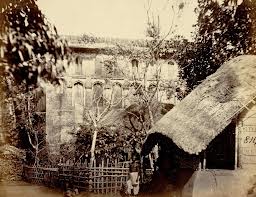 In actual fact however, tea was still hugely expensive, partly because of the Company’s monopoly on the trade and partly because of the extortionate taxes imposed upon it. To satisfy the demand of the less wealthy, an enormous amount of tea was smuggled into Britain and sold illegally. This situation continued for years, until William Pitt the Younger came to power as Prime Minister in 1783. With the Commutation Act of 1784, he slashed the tax on tea so dramatically that smuggling became pointless. Thereafter virtually all tea was imported legally by the East India Company.
In the decades leading up to Pitt the Younger’s Commutation Act, tea smuggling had really crippled the East India Company. Needing to increase profits and offload surplus tea that the Company had accumulated during the worst years of the smuggling, it asked the British government for permission to export direct to America, which at this time was still a British colony. Permission was granted, and it was decided that the tea would carry a tax of 3d per lb. The Americans were outraged, many considered such British-imposed taxes wrong because they wished to self-govern. There wasalso the small matter of the East India Company having the monopoly on distribution, another move that was intended to help it out of financial trouble, but which offended the Americans who felt they should have the right to distribute their own tea.
When the Company’s ships arrived in Boston in late 1773, the townspeople were determined that the tea should not be brought ashore nor the duty on it on paid. But the colonial administration would not allow the ships to leave port. The deadlock eventually resulted in the Boston Tea Party, when a mass of townspeople, dressed as Native Americans, boarded the ships and threw all the cargo of tea overboard. This was one of the key events that eventually sparked the American War of Independence.
When America eventually won independence from British rule in 1783, it began its own free and independent tea trade with China. The success of this trade made some people in Britain question the wisdom of allowing the East India Company a continued monopoly on British trade with the East.They felt there should be free trade instead. In 1813, the Company lost its monopoly on trade with India, but still had a complete monopoly on trade with China, which meant it was heavily dependent on the tea trade. The Company’s charter was due for renewal in 1834, and in the decades before that there was a growing call for the abolition of the monopoly and the instigation of free trade with China as well. Supporters of free trade argued strongly that the Company kept tea prices artificially high in order to maximise its profits, using tactics which included restricting the supply of tea.
The movement gathered pace, and committees were set up by free trade organisations to examine the evidence. The report of one such committee in 1828 claimed that the restriction of supply by the East India Company, and the artificially high prices, had actually driven down the annual consumption of duty-paid tea per person in Britain, from almost 28oz in 1800 to just 20oz in 1828. An added complication was that Charles II’s charter to the Company had allowed it to use military force where necessary to establish trading stations, and in the seventeenth and eigthteenth centuries it established many well-fortified trading posts in India. Over the course of the eighteenth century, the control of the Mughal Emperor in Delhi was in decline, with independent regional princes taking power instead. But unhappy with this turn of events, the Company increasingly used its private army to establish governmental control over large territories of India. By the beginning of the nineteenth century, with help from the British army, the Company had conquered about half of India
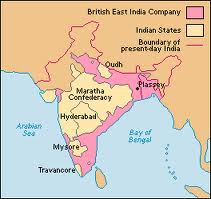 Thus India was being ruled by tea merchants from the East India Company boardroom in Leadenhall St, London. This caused great concern to many in Britain, who considered the dual roles of merchant and ruler to be completely incompatible. In 1834, Parliament’s new charter for the Company abolished its trading functions altogether. Instead, the Company became an agent of the British government, administering British India on behalf of the Crown. India was still to be ruled from the boardroom of the East India Company, but its rulers would no longer also be tea dealers. China was still the major source of tea, and since the Company had now been relieved of any trading rights with China, its thoughts turned to the possibility of growing tea in India. Previously, when the Company had had a monopoly on the Chinese trade, it had not been in its interests to encourage cultivation of tea elsewhere.
A Tea Committee was established to investigate where in India might be most suitable for the cultivation of tea plants and seed imported from China, and to oversee that cultivation. One obvious area was Assam, where indigenous tea plants had already been found growing. Seeds from China were germinated in Calcutta and then sent on to Assam and other areas to conduct trials. C.A. Bruce, an agent of the East India Company in Assam, was appointed Superintendent of Tea Forests and set about cultivating plantations of both China tea and indigenous tea.
In 1838 12 chests of Assam tea were sent to the East India Company in London. Some was used for public relations purposes and the rest went to the London Tea Auction. This was the first auction of Assam tea in London, and the novelty of the product ensured that it got a very good price. Bruce’s experiment had been a resounding success. A new organisation, the Assam Company, was formed to exploit the potential of Assam tea. By 1855 tea cultivation in Assam amounted to over half a million lbs.
Despite the fact that the East India Company had lost its trading rights, but it had not lost its desire to make money. The cost of the Company’s of India administration was met through punitive taxation of the Indian people. There were localised rebellions and the Company used increasingly heavy-handed tactics to control the Indian population. In May 1857 three regiments of Indian soldiers serving in the Company’s army at Meerut near Delhi rebelled. The revolt spread, and led to a vicious conflict as the British forces tried to put it down. The rebellion lasted over a year, during which time both sides committed acts of terrible cruelty. Even after peace was established, the trust between the Indians and the East India Company administration was destroyed. The British government decided that enough was enough, and directly assumed all the Company’s powers and possessions in India. The first viceroy, Lord Canning, was appointed to govern British India.
The power of the East India Company was well and truly over, but the success of Indian tea production was just beginning. With the exception of Darjeeling, which was producing high-quality but low-yielding tea crops, there was little tea cultivation outside Assam. The new British administration in India saw the potential for more widespread cultivation and offered generous land leases to would-be tea planters. By 1888 Indian tea production had reached 86 million lbs – and for the first time British tea imports from India exceeded those from China.
 Caro Field Author
What an excellent post. Well researched and thought out. I sure learned a few new things.
a href=”http://historysleuth.blogspot.com/”>History Sleuth’s Writing UBC
Thank you so much…praise indeed!