
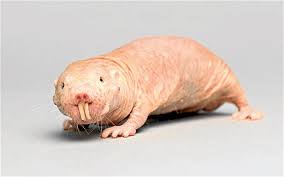
 Heterocephalus glaber, the naked mole rat, is a fleshy, furless, buck-toothed East African creature that is so ugly, it almost has a certain kind of charm! Judge for yourself. These mammals are neither moles nor rats, and socially they behave more like bees, wasps, ants, and termites than to other vertebrates.
They live in underground colonies of up to 300 individuals with a dominant breeding ‘queen’ and celibate soldiers and workers. Until the late 1970s scientists believed that this trait was confined to insects. About the size of a large mouse or a small hamster, they are nearly blind and almost completely hairless. They have very prominent incisors that stick beyond their lips, which they use to dig with. Their wrinkled bodies are extremely well formed for moving through narrow passages, and they can move backwards just as easily as forwards.
Naked mole rats are apparently impervious to pain, survive in very low oxygen levels and are resistant to cancer. Despite exhaustive research, scientists have never seen malignant tumours in mole rats. Studies indicate that mole rats cells may exhibit a form of ‘early contact inhibition’, in which replicating cells recognise their neighbours and cease dividing almost immediately. This acts as a fail-safe to stop potentially cancerous cells from multiplying beyond a critical density. Researchers are uncertain why evolution prompted this improvement, but they are keen to find a way to capitalize on it for humanity.
The social structure of a naked mole rat colony mirrors that of a beehive or ant nest, with a single breeding female at its head. Ninety eight percent of the members of a colony will be infertile, with between one and three males providing sperm for the queen.The queen firmly establishes the social hierarchy by bullying; displays of head-shoving and clambering over her subordinates. Junior mole rats respond with a physiological stress reaction that effectively suppresses sperm production or ovulation. Freed of the demands of reproduction, celibate workers can devote their energies to tending to the queen’s young or collecting underground plant roots to feed the rest of the colony. Meanwhile, higher status rodents form a “soldier caste” that defends the burrow from predatory snakes or other mole rats.
When an old queen dies, the female soldiers engage in battle. After much head-butting and clambering, a single victor becomes the new queen and the most powerful males become her royal consorts. Then the young queen grows noticeably larger and longer than her workers, as the vertebrae in her spine spread to accommodate an almost continuous state of pregnancy. Relieved of suckling duties by her celibate minions, she can concentrate on breeding rather than nursing. Almost uniquely among mammals, naked mole rat queens can therefore have litter sizes larger than the number of nipples available for suckling.
The air inside a mole rat burrow has incredibly high levels of carbon dioxide and low levels of oxygen. The high carbon dioxide concentration increases acid in the rodents’ tissue fluid to levels that would leave most mammals writhing in agony. Researchers discovered that a mutation in a single gene has switched off this response in mole rats, allowing them to adapt to what would otherwise be an extremely uncomfortable environment-, and incidentally, giving them an extraordinary tolerance to pain. This capability has piqued the interest of medical scientists looking to develop new human painkillers.
Naked mole rats’ tolerance of low oxygen levels may hold the key to improving human health. In most mammals, brain tissue is very sensitive to low oxygen levels, yet a mole rat neuron can survive in conditions of oxygen deprivation, or hypoxia, six times as long as a corresponding mouse neuron. It is thought that naked mole rat brain cells retain features of immature but hypoxia-tolerant foetal neurons. Stroke researchers are keen to harness these insights for the treatment of human hypoxic brain injury.
Naked mole rats can live up to 30 years, which is an astonishingly long lifespan for a small rodent. Scientists do not fully understand the reasons behind this, although they have a low metabolic rate, which may also contribute to their hypoxia tolerance , and this helps. Task-specialization also seems to promote long life, old age being particularly common among creatures that care for their young communally. These include mole rats, social insects, bats, and humans, all of which live much longer than would be expected on the basis of their body mass alone. Furthermore, over-frequent death becomes inconvenient, wasteful, and unsanitary in an over-crowded burrow. Colony hygiene is paramount when mortality finally asserts itself, and, unusually among non-human mammals, naked mole rats will always bury their dead. The mole rat in a nutshell. An extraordinarily ugly little rodent, that may give us enormous medical advances by its mere existence. Nature at its coolest.
 Caro Field Author
Learn something each day, I am now well informed on the mole-rat, which I had no idea even existed when I got up this morning. This is very interesting, but for me a better question is what brought you to share this information with us.
I happened to catch a medical piece about it and wanted to learn more…
And, what spiked your interest in the creatures?
…the medical advances that might be made by studying them…
Caro,
I’ve got to admit that I always avoid the naked mole rat display at the zoo, in the same way that I avoid the tank with the hissing cockroaches. But in your lovely way, you’ve given me a reason to study these creatures more closely. The lesson, perhaps, for me is you just can’t judge a critter by its appearances. Thank you!
…I know!What ugly creatures! But fascinating what we might discover by studying them more closely…
What a fascinating post. It’s hard to imagine what could be possible with learning from these creatures.
Thank you for saying so Nanette. And they may be ugly, but these little creatures seem to hold the key to us learning the most astonishing ways to help cure or arrest all kinds of health problems…nature at its coolest!