
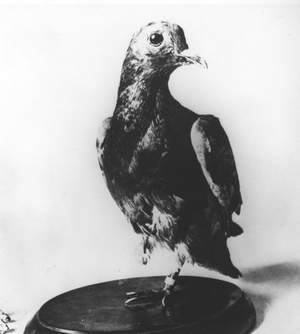
 The pigeon, a bird that is often much maligned, is a very unlikely hero. Why? Because they were used through both World Wars, as the most reliable form of communication, particularly during the First World War, before the advent of radio or telegraph. General John Pershing ordered the American Signal Corps to build a pigeon ‘battalion’ during WWI, when it is estimated that half a million birds were used on both sides. These birds had an astonishing 95% success rate at completing their missions.
Maria Dickin, founder of the PDSA (The People’s Dispensary for Sick Animals), the UK’s leading veterinary charity, founded the Dickin Medal in 1943, to honour animals who display outstanding bravery. It is considered the animal equivalent of the Victoria Cross and pigeons hold more of these awards than any other creature, they hold 32 of them. In fact pigeons also hold the Purple Heart, and the Distinguished Service Medal (USA) and the Croix de Guerre with palm (France).
One of the most famous birds to be honoured in this way was a homing pigeon called Cher Ami (French for dear friend), who saved an 800 man ‘lost battalion’ that was coming under friendly fire because they had advanced too far behind enemy lines. The battalion’s only chance of survival lay with this bird, which, once released, was repeatedly shot at by German soldiers. Cher Ami was downed by a shot through the breast, yet struggled back into the air, and flew the 25 miles (40.2 km) to its command post. By the time he got home, he had one eye shot out and was missing most of his leg. The message to the command post was retrieved because it still clung to the tendon that was the only thing holding his leg on…the message stopped the shelling and the battalion was saved. After healing, Cher Ami returned to America, where he died in 1919, was mounted and placed on display in the Smithsonian Institute. He was awarded both the Dickin Medal and the Croix de Guerre with Palm.
Another such bird was G.I. Joe, which flew 16.8 miles (30 km) in just 20 minutes and saved the lives of 1,000 soldiers by carrying a message to cancel a bombardment of Colvi Vecchia, which the British had entered ahead of schedule. For the feat, the bird was awarded the Dicken Medal, the only U.S. war pigeon to do so.
When WWII broke out homing pigeons were once again put to good use by both sides.In fact Heinrich Himmler was commander of the German national pigeon organisation and had 50,000 birds at his disposal. These birds were not just used to carry communiqués, they also had cameras mounted under them so they could photograph troops, equipment, factories in towns, etc. Both Germans and English developed falcon squadrons too, to intercept these winged spies.
These birds did not achieve these astonishing feats without their handlers. One of the most famous pigeoneers of all time was Col. Clifford Poutre of the US Army who was stationed at the pigeon lofts at Fort Monmouth, New Jersey. He is credited with doing away with the notion that you had to starve a homing pigeon to make it return home, instead he made their lives so pleasant that they wanted to return. He is also credited with several amazing feats unprecedented in pigeon-keeping history. He trained his pigeons so that they knew:
– how to return to a mobile pigeon loft even after it had been moved ten miles from where the pigeon departed;
– how to carry packages, parcels, and small cameras on their backs, chests and legs;
– how to fly at night and without stopping for up to twenty-four hours;
– how to carry a canary piggy-back from New Jersey to a loft on the New York City rooftops.
Pigeons were carried on every Lancaster Bomber in case a crew was shot down or had to ditch their plane, in order that they could be located and rescued. Many were saved by this. The army also developed a special cage and parachute for dropping pigeons from aircraft to supply isolated troops with a means of communication. The device was also used to drop thousands of pigeons over the countryside during the June 1944 Normandy Invasion. French civilians were asked to send back detailed information about German installations and troop movements. So next time you curse at a pigeon that gets underfoot, remember, they may have heroic forebears!
 Caro Field Author
I had no idea. Absolutely fascinating!!
…and to think we normally consider them pests
Whoa, Caro, these are inspiring stories! I had no idea that these pigeons had been such heroic figures in our history. I’m going to share this with little Mack. Thanks for sharing this. (Now I want to travel to see the Smithsonian display).
It is quite humbling how heroic they were……..
Ah….I’ll just wait to see the pigeon races…
…THEY ARE COOL BIRDS…
People insult other people by calling them “bird-brained,” but birds are quite smart apparently. For birds to save the lives of people in war is definitely heroic and requires a brain!
They are super bright!
Very interesting. Now if you could only outfit them with diapers!
True!
My gosh! There is a Dickin Memorial Animal Hospital near where I live in upstate New York. I always wondered where the name came from. Now I know! I went to their website just now and they had a link to PDSA on their home page. I am a native of New York City, where a lot of people used to keep pigeons in rooftop coops.
…what a small world it is!